Head of the Moroccan government Aziz Akhannouch highlighted centuries‑old ties with Senegal, describing relations between the two countries as rooted in deep human, religious, economic and cultural links.
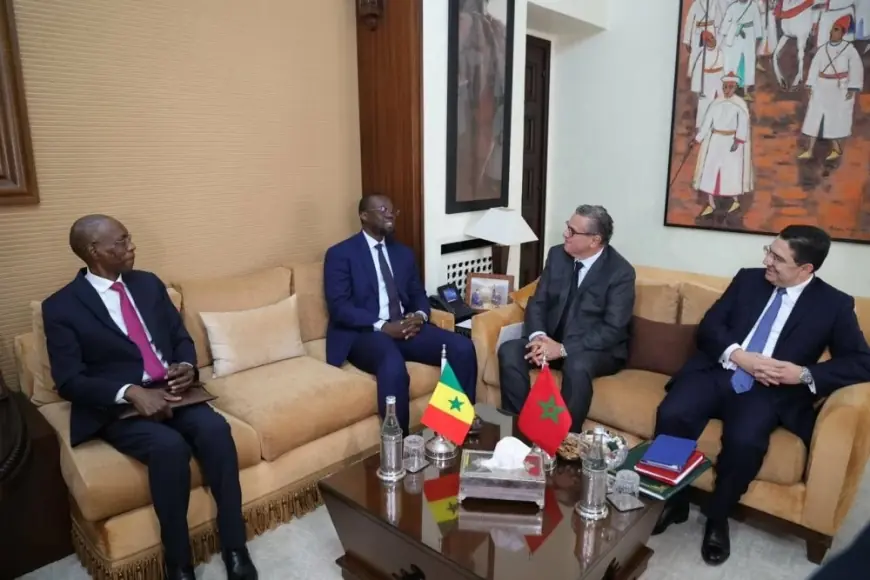
Akhannouch was speaking at the opening of the 15th session of the Moroccan‑Senegalese joint commission in Rabat, one week after the African cup of Nations final which was marred by regrettable behaviour by Senegalese players and coach, which is being reviewed ahead of disciplinary measures by CAF.
Sports is viewed by Morocco as a tool for rapprochement between peoples rather than a source of division, Akhannouch said, noting that the recent African Cup of Nations hosted by Morocco remained a landmark event for the continent.
\Akhannouch said Morocco’s approach to sport went beyond competition and results, aiming instead to promote human development and strengthen Africa’s global standing. He added that Morocco would seek to project the same vision when it co‑hosts the 2030 World Cup alongside Spain and Portugal.
Akhannouch welcomed Senegalese Prime Minister Ousmane Sonko and said the meeting reflected a shared determination by both governments to deepen multi‑dimensional cooperation in line with the vision of King Mohammed VI and Senegal’s President Bassirou Diomaye Faye.
Relations between Morocco and Senegal stretched back several centuries and were grounded in long‑standing exchanges between peoples, trade routes linking Morocco to sub‑Saharan Africa via Senegal, and close cultural and social interaction, he said.
“These ties are natural and enduring, not the product of momentary circumstances or temporary alliances,” he said.
The prime minister also pointed to the religious and spiritual dimension of the relationship, citing links fostered through Islamic institutions and Sufi brotherhoods, notably the Tijaniyya order, as cornerstones of ties between the two countries.
He said the strength of bilateral relations was reflected in more than 140 cooperation agreements and by eight visits by King Mohammed VI to Senegal, describing the partnership as a model of African cooperation based on solidarity and mutual respect.
The joint commission, he said, provided an opportunity to assess progress since its previous session and to give new momentum to cooperation, including through the signing of additional agreements covering priority sectors and by encouraging greater involvement from the private sector.
Akhannouch said Morocco and Senegal shared a common vision for African integration and regional stability, particularly in the Sahel and Atlantic regions, and highlighted Moroccan initiatives aimed at deepening cooperation across the continent, including plans to facilitate Sahel countries’ access to the Atlantic Ocean and a gas pipeline project linking Nigeria to Morocco.
He also praised Senegal’s support for Morocco’s sovereignty over the Sahara territory.
Concluding his remarks, Akhannouch said Morocco and Senegal would remain committed to strengthening their strategic partnership and advancing cooperation “to the highest levels,” guided by the political will expressed by the leaders of both countries.