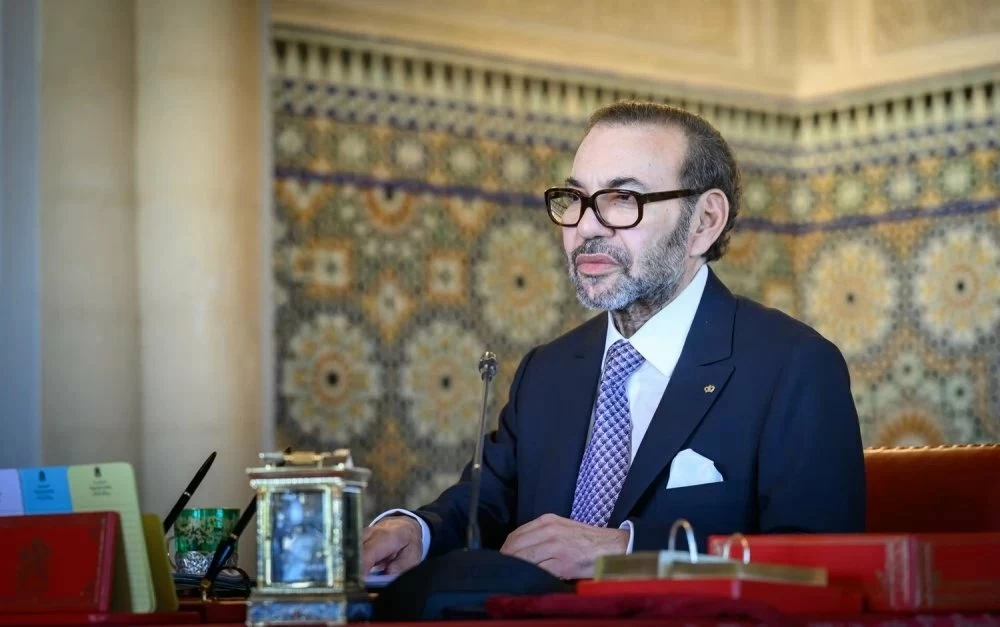
King Mohammed VI chaired a Council of Ministers on Sunday at the Royal Palace in Rabat to approve the general orientations of Morocco’s 2026 Finance Bill, which places territorial development and social investment at the heart of government priorities.
The draft budget, presented by Economy and Finance Minister Nadia Fettah Alaoui, seeks to consolidate economic gains while addressing regional disparities and strengthening the foundations of the social state.
The Finance Bill comes amid global economic uncertainty but builds on Morocco’s strong performance, with growth projected at 4.8% for 2025, inflation contained at 1.1%, and the fiscal deficit expected to narrow to 3.5% of GDP.
The government aims to sustain this momentum through measures that stimulate private and foreign investment, accelerate the implementation of the Investment Charter, and advance Morocco’s green hydrogen strategy, while reinforcing public-private partnerships and diversifying financing sources.
A major focus of the 2026 budget is the launch of a new generation of integrated territorial development programs designed to reduce regional inequalities and promote solidarity between regions.
These programs will prioritize job creation for young people, the upgrading of education and healthcare services, and the development of vulnerable areas such as mountain regions and oases.
The government also plans to extend the national program for developing emerging rural centers and promote sustainable development along the country’s coastline.
Social investment will see a significant boost, with an allocation of 140 billion dirhams for health and education and the creation of more than 27,000 new positions in these sectors. In healthcare, the plan includes commissioning university hospitals in Agadir and Laâyoune, completing the Ibn Sina Hospital in Rabat, and continuing construction of facilities in Béni Mellal, Guelmim, and Errachidia, alongside the renovation of 90 hospitals nationwide. Education reforms will accelerate the rollout of preschool education, strengthen support services, and improve teaching quality.
The Finance Bill also reinforces Morocco’s social protection system, operationalizing direct aid for four million households and increasing child support allowances, while expanding pension coverage and unemployment benefits. Structural reforms will continue with the modernization of public finance governance, restructuring of state-owned enterprises, and judicial reforms aimed at improving the business climate.
The Council further adopted two military decrees, including a new status for officials in the Directorate of Information Systems Security and updated regulations for the Royal School of Military Health Service. A Scientific Research Council will also be established to guide defense-related innovation.