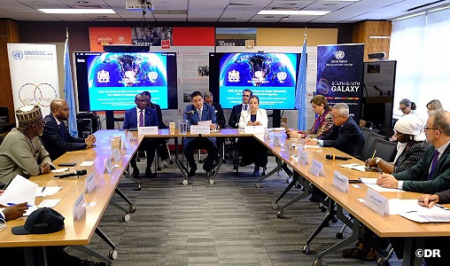
Morocco organized a high-level event on “Harnessing the Power of Sport for Social Inclusion and Migration” on Friday at the United Nations headquarters in New York.
Held in partnership with the International Organization for Migration (IOM) as part of the 80th session of the United Nations General Assembly, the meeting brought together ministers, senior representatives of UN member states, senior officials from international organizations and sports federations, as well as representatives of civil society and figures from the academic world.
The event was an opportunity to highlight the contribution of sport as a vehicle for social cohesion, combating stigma and promoting universal values of tolerance, solidarity, and respect.
This high-level meeting provided a platform to explore concrete partnerships between states, international organizations, sports institutions, and civil society actors to strengthen the impact of sport to the benefit of migrants and host societies.
As part of preparations for the International Migration Review Forum (IMRF), scheduled for 2026, this initiative has helped identify innovative means to bolster international cooperation on sport and migration governance.
In an address during the event, Minister of Foreign Affairs Nasser Bourita called for sport to be used as a strategic lever for more humane and inclusive migration governance, noting that sport is far more than a leisurely activity.
“It is an immediate vehicle for integration, a space for recognition and an inspiring framework for rethinking migration governance,” he stressed. “On the field, a migrant is not a stranger, but a teammate, a competitor, a talent, a human being.”
He said that sport offers valuable lessons: integration is natural, universal rules coexist with local adaptations, international cooperation works through global federations and committees and human values are firmly upheld, particularly in the face of racism.
These dimensions, he said, “provide a useful model for strengthening inclusion and building a new, objective and positive narrative around migration.”
Reflecting on Morocco’s experience, Bourita cited the striking example of the 2022 World Cup in Qatar, where the national team, with many players from the diaspora, proved that integration in their countries of residence could boost pride and unity in their countries of origin.
He also underlined the fundamental role of mothers in the integration process of young migrants, recalling the historic reception of the national team and their mothers by King Mohammed VI, an outstanding testimony to the contribution of athletes’ mothers.
Looking ahead, the minister emphasized that Morocco will turn the 2025 Africa Cup of Nations and the 2030 World Cup into opportunities to promote its values of hospitality, diversity and tolerance, all while highlighting the role of diasporas and migrant communities.
Bourita also put forward three key proposals: making sport a pillar of the international migration landscape; integrating the contribution of migrant athletes into the review process of the Global Compact for Safe, Orderly, and Regular Migration; and launching a “Group of Friends for Sport and Migration,” bringing together states, international organizations, sports institutions, and civil society.
He called in this connection on the international community to transform sports fields into places of opportunity for a more humane, inclusive, and unifying approach to migration governance.