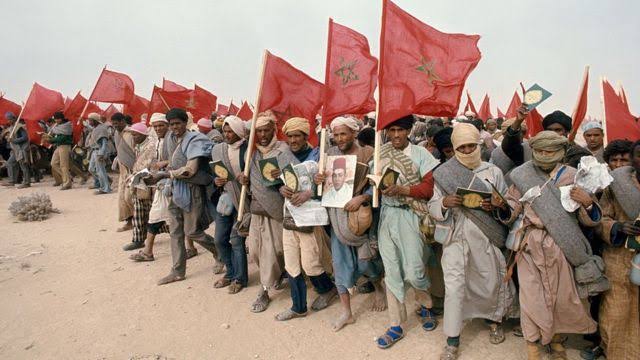
Morocco is celebrating this November 6 the 51st anniversary of the Green March, an epic in Morocco’s contemporary history. The March mobilized 350,000 volunteers in a peaceful movement, as the marchers were carrying only copies of the Holy Koran and the Moroccan flags. This peaceful march, launched organized by the late King Hassan II on Nov. 6, 1975, would become one of the defining moments in Morocco’s modern history. 350,000 volunteers from across Morocco answered Hassan II’s call to advance into the territory, then under Spanish dominion. Their mobilization helped accelerate Spain’s withdrawal, opening a new chapter in Morocco’s efforts to consolidate its territorial claims.
Today, this national event continues to symbolize the country’s unity, national sovereignty and the struggle to protect territorial integrity. It is also a reference point for understanding the transformation of the southern provinces, now central to the kingdom’s economic, diplomatic and geostrategic ambitions.
This year, more than five decades later, the anniversary comes amid renewed diplomatic attention to the Moroccan Sahara.
Actually, this year’s anniversary is celebrated just days after Russia vetoed a U.S.-drafted resolution at the U.N. Security Council on Oct. 30. Eleven members supported the proposal, which sought to strengthen Morocco’s autonomy plan as the basis for negotiations and to restructure the U.N. MINURSO.
The Security council also failed to adopt a competing Russian resolution seeking to extend the mission’s mandate for another year.
Following the vote, Morocco’s Royal Office announced that MINURSO’s mandate had expired and called for the withdrawal of its personnel and equipment from the southern provinces. Rabat described the development as a significant step toward resolving the decades-old territorial dispute.
The diplomatic developments prompted Morocco’s two Chambers of the parliament to hold on Monday Nov.2 a joint session that expressed support for King Mohammed VI’s approach to the Sahara issue and endorsed the kingdom’s position on MINURSO’s future.
On Wednesday Nov.4, the king chaired a working session at the Royal Palace in Rabat with Head of Government Fatima Ezzahra El Mansouri and senior officials to discuss arrangements following the expiration of MINURSO’s mandate.
The Monarch instructed authorities to safeguard national security, coordinate the mission’s withdrawal, and continue development projects in the southern provinces.
Actually, beyond diplomacy, Morocco has pursued an ambitious development strategy in its southern provinces. Since King Mohammed VI launched a regional development program in 2015, investments in ports, infrastructure, renewable energy, and public services have sought to strengthen economic activity and regional connectivity.
Major initiatives, including plans to provide landlocked Sahel countries with access to the Atlantic Ocean and the proposed Africa-Atlantic pipeline, also reflect Rabat’s ambition to position its southern provinces as a gateway between Africa and international markets.
For Morocco, the Green March remains more than a chapter in its history. Fifty-one years after the first volunteers crossed the desert, its legacy continues to influence the kingdom’s diplomacy, development priorities, and vision of national unity.