From Tanger Med to Nador West Med and Dakhla Atlantic, Morocco’s emergence as a leading maritime power reflects a long-term strategy championed by King Mohammed VI to transform the Kingdom into a gateway for global trade, regional integration and African development.
Over the past two decades, the Kingdom has moved beyond a traditional port system to build an integrated network anchored by Tanger Med, the emerging Nador West Med, and the future Dakhla Atlantic Port, all key pillars of Morocco’s National Port Strategy 2030.
The strategy reflects the King’s broader ambition to leverage Morocco’s unique geography at the crossroads of Europe, Africa and the Atlantic, to attract investment, strengthen industrial competitiveness and position the Kingdom as a gateway for global trade.
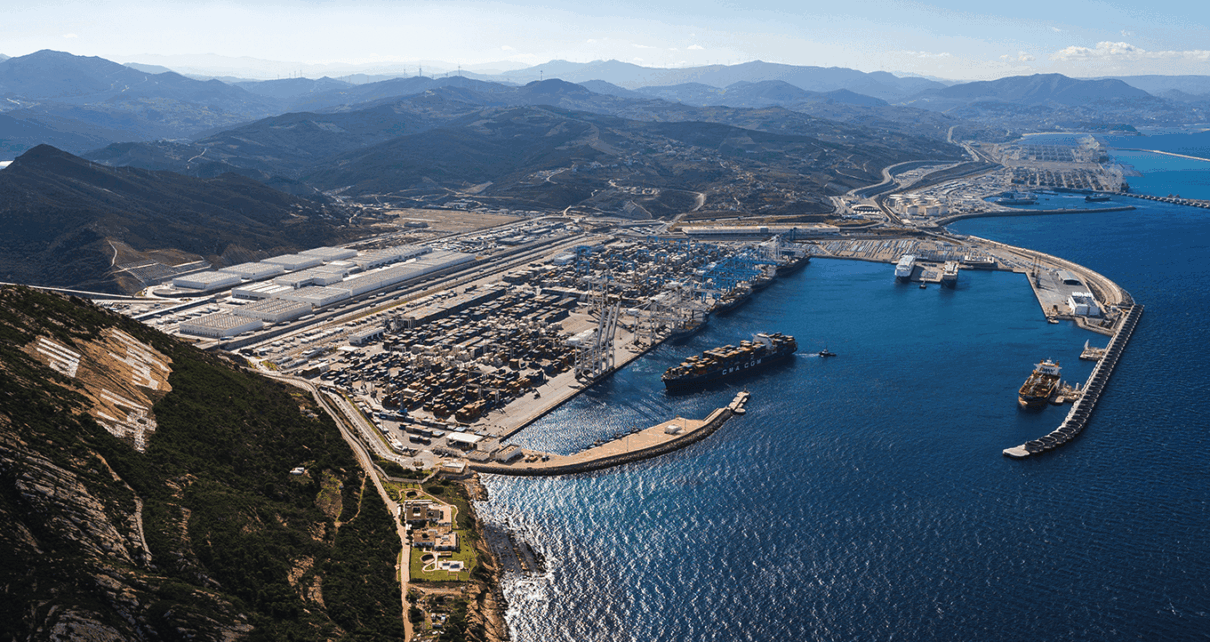
The success story began with Tanger Med, launched under the leadership of King Mohammed VI and now one of the Mediterranean’s largest container hubs. In 2025, Tanger Med kept its standing as Africa’s and the Mediterranean’s top port handling more than 8 million TEUs annually and supporting industrial zones hosting around 1,400 companies and 130,000 jobs across automotive, aeronautics, textiles, food processing and renewable energy sectors.
Rather than viewing Tanger Med as a standalone project, the King’s vision has been to create a network of complementary ports serving different regions and trade corridors.
In northeastern Morocco, Nador West Med is scheduled to begin operations in the fourth quarter of 2026. The project is designed to complement Tanger Med while expanding Morocco’s transshipment, energy and industrial capabilities.
The port will initially have the capacity to handle around 5 million containers annually, alongside 35 million tonnes of liquid and dry bulk cargo, with significant expansion potential over time.
Nador West Med is also expected to host Morocco’s first LNG import infrastructure and a vast industrial and logistics ecosystem stretching across hundreds of hectares.
Further south, the Dakhla Atlantic Port represents perhaps the most strategic element of King Mohammed VI’s Atlantic vision.
With an investment exceeding 12 billion dirhams, the deep-water port is designed to handle approximately 35 million tonnes of cargo annually and will be supported by a 1,650-hectare industrial and logistics zone.
The project is closely linked to the Royal Atlantic Initiative, launched by King Mohammed VI to provide Sahel countries with greater access to Atlantic trade routes. The port is envisioned as a gateway for Mali, Niger, Burkina Faso and other landlocked states seeking access to global markets.
Together, Tanger Med, Nador West Med and Dakhla Atlantic form the backbone of a maritime strategy that extends beyond shipping. The ports are intended to support industrialization, green hydrogen exports, energy security, logistics services and stronger African integration.