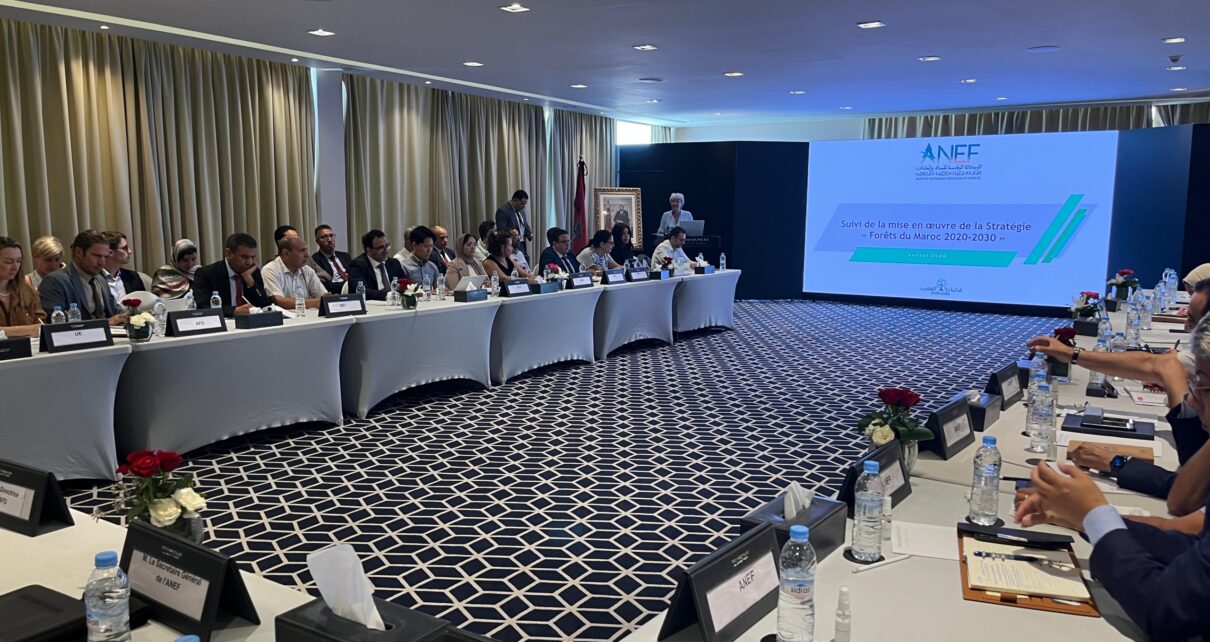
Morocco’s National Agency for Water and Forests (ANEF) has secured more than €580 million in international financing for its “Forests of Morocco 2020-2030” strategy, with some €175 million — approximately 40 percent of total commitments, equivalent to 1.9 billion dirhams — already disbursed. The figures were disclosed at a high-level review meeting in Rabat on Thursday, chaired by ANEF Director General Abderrahim Houmy in the presence of representatives of bilateral and multilateral institutions including the Agence Française de Développement, the Food and Agriculture Organization, the African Development Bank and the European Investment Bank.
Launched by King Mohammed VI in February 2020, the strategy covers approximately 9 million hectares, including 5.8 million hectares of natural forest, and is structured around 17 programs. Its design responded to a documented crisis: before 2020, Morocco was losing around 17,000 hectares of forest cover annually through degradation, firewood harvesting exceeded natural regeneration, and overgrazing compounded the impact of accelerating climate change. Financing is channeled toward ecosystem restoration, biodiversity preservation, watershed management, the development of forest value chains and the improvement of conditions for rural communities.
Progress across governance and community engagement has been substantial. Some 147 communes — 74 percent of those targeted — are now enrolled in territorial coordination arrangements. Seventy-three forest development bodies have been established and 54 concerted development plans drawn up. To encourage community participation in protection efforts, the ANEF provided compensation in 2025 to 530 protective perimeters covering 80,000 hectares at a cost of 45 million dirhams, directing funds toward livestock feed, agricultural equipment, rural road construction, well-drilling, school transport and solar installations. Under the Ghabati Hayati program, 237,289 hectares have been compensated, representing 64.7 percent of the 366,846-hectare target.
The cooperative sector has expanded alongside governance structures. Some 310 forestry cooperatives are now active under 273 ANEF contracts, grouping nearly 19,400 members and generating around 15 million dirhams in annual revenue. Reforestation remains a central pillar: the ANEF is targeting the restoration of 600,000 hectares by 2030, prioritizing mountain zones and native species better adapted to climate stress, using mechanized soil preparation, Waterboxx planting systems and drone-assisted monitoring. The agency is also developing ecotourism infrastructure across its network of ten national parks.
FAO Representative Alexandre Anh Tai Huynh praised Morocco’s approach as an innovative model that integrates biodiversity conservation, forest protection and anti-degradation measures in a way unique to the country. AFD Director Catherine Bonnaud described the bilateral partnership as crucial for strengthening ecosystem resilience and climate adaptation. The ANEF indicated that it intends to extend the strategy’s international footprint through South-South and triangular cooperation, feeding into Morocco’s broader commitments on climate, biodiversity and desertification.