France reiterated that the “present and future of the Sahara lie within the framework of Moroccan sovereignty” and outlined the precise measures to apply this decision.
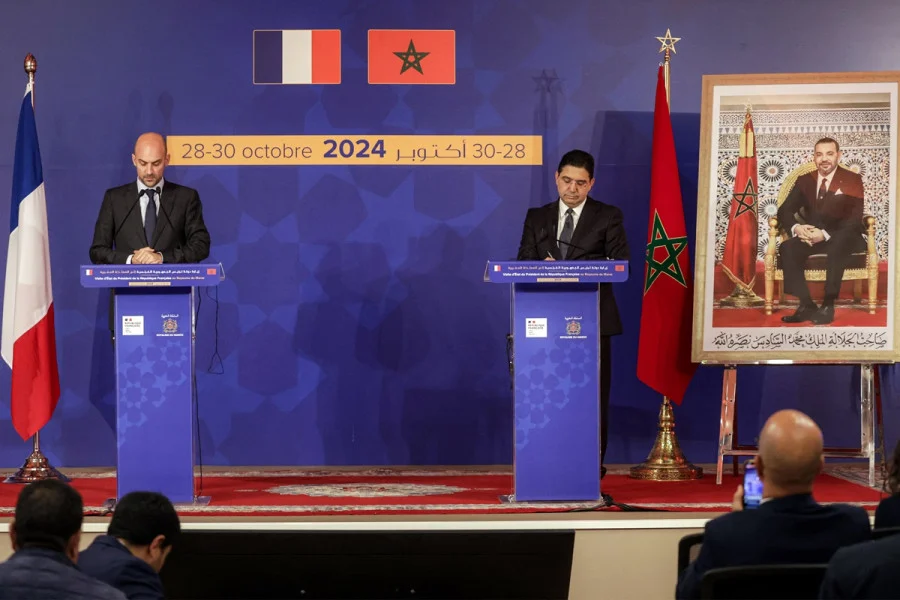
This position was expressed on Wedneday in Rabat by French Minister of Foreign Affairs Jean-Noël Barrot in a joint press briefing following his talks with his Moroccan peer Nasser Bourita.
Underlining the strategic significance of the Sahara issue to France and the region, Barrot recalled that in line with the stance conveyed by French President Emmanuel Macron in his letter to King Mohammed VI, on July 30, 2024, “the present and future of this territory lie within the framework of Moroccan sovereignty.”
In this respect, the French official affirmed “France’s support for the autonomy plan put forward by Morocco as the only basis for a just, lasting and negotiated political solution.”
He added that “the UN Security Council’s Resolution 2797 lies within this logic,” and that France “hails this positive momentum, as well as the resumption of direct talks among all the stakeholders on the basis of the autonomy plan.”
Regarding the measures taken by France in implementation of this position, Barrot said that his country has “expanded its consular presence” and “cultural activities,” with the opening of a visa application submission center, the establishment of an “Alliance Française” in Laayoune, and the inauguration of a new school.
On the economic front, he noted that the French companies invest in the Sahara, with the French development agency (Agence française de développement) and operators providing relevant support.
Bourita on his part said that Moroccan-French partnership is experiencing its most important and strongest momentum at all levels and stressed that this partnership contributes not only to strengthening relations between the two countries, but also has an impact on security and stability at the regional level.
He noted that Barrot’s visit, within the framework of the 2nd Ministerial Conference on Peacekeeping in a Francophone Environment, co-chaired by Morocco and France, comes in a very positive context for the Moroccan-French partnership, strengthened during the State visit in October 2024 by President Emmanuel Macron and his talks with King Mohammed VI.
Since then, more than 40 meetings have brought together Moroccan and French ministers, illustrating the strength of bilateral relations, Bourita noted, adding that these meetings have largely contributed to consolidating partnerships in several fields, notably economic, security, consular and human affairs.
They have also made it possible to open new prospects for advanced cooperation in key sectors such as cybersecurity, defense industries and aeronautics, he pointed out, noting that these sectors reflect “a strong and technology-oriented partnership focused on the future between Morocco and France.”
Moreover, he noted that the 2nd Ministerial Conference on Peacekeeping in a Francophone Environment aims to transform the significant contribution of Francophone countries to peacekeeping operations into a real lever of influence and concrete tools serving security, stability and peacebuilding within the Francophone sphere and beyond.
He stressed that the “Rabat Declaration,” adopted during this conference, will serve as a reference for Francophone countries in their contribution to the reform of United Nations peacekeeping operations scheduled for the coming months, so that these States can “speak with one voice and work to make these operations more effective and more efficient.”
This Declaration insists on the need to adapt peacekeeping missions to realities on the ground and to avoid terminology or mandates that have become outdated and unsuited to developments in the field, he emphasized.
After praising the French contribution to the success of this conference, Bourita assured that Morocco and France will continue their action as co-chairs in order, initially, to present the conclusions of the “Rabat Declaration” to States and within the United Nations, with the aim of making it a reference in the management and reform of peacekeeping operations at the UN level.
The minister also indicated that the meeting with Barrot provided an opportunity to discuss several regional and international issues and once again commend France’s clear position regarding the Moroccan Sahara issue.
This position, which was not limited to a statement, “was followed by structured actions and initiatives moving toward an objective shared by the leaders of the two countries,” namely that “the current dynamic does not seek to designate a winner and a loser, but to put an end to this regional dispute with its human consequences and repercussions on the stability and economy of the region,” he stressed.
Bourita highlighted the opportunity currently available to resolve this regional dispute within the framework of the Autonomy Plan under Moroccan sovereignty as the sole basis for settlement, specifying that this initiative has now become a UN reference in light of UN Security Council Resolution 2797.
He affirmed that the French position aligns with that of the United Nations as expressed in the Security Council resolution, expressing hope for positive results that would put an end to this artificial conflict.
On another matter, the minister indicated that discussions also covered the situation in the Middle East, the Sahel-Saharan region and Africa, noting the convergence of views and the determination of both countries to act together, as partners, in favor of stability and development on the African continent.