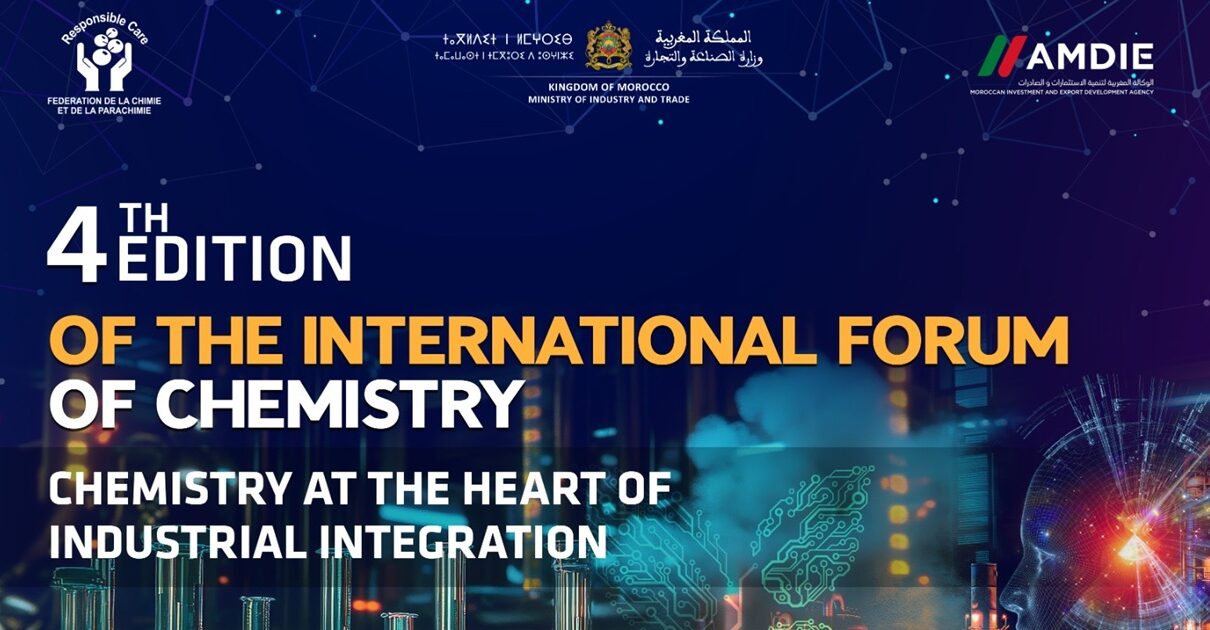
The fourth edition of the International Chemistry Forum, organized jointly by the Federation of Chemistry and Para-Chemistry (FCP) and the Ministry of Industry and Trade, opened in Rabat on May 13 under the theme “Chemistry at the Heart of Industrial Integration,” bringing together industry leaders, policymakers, and international partners to assess the sector’s performance and chart its transformation toward a more integrated, competitive, and sustainable model.
The numbers presented at the opening session confirm the sector’s fundamental strength. In 2024, Morocco’s chemical industry generated revenues of more than 180 billion dirhams and directly employed more than 180,000 people. Total production value reached 180 billion dirhams, investments approached 50 billion dirhams, and close to half of output was directed toward export markets.
FCP President Abed Chagar described the sector as the transversal link connecting energy, mining, agriculture, automotive, batteries, advanced materials, and the entire manufacturing economy — and called for an industry that is fully integrated, competitive, and resilient.
Industry and Trade Minister Ryad Mezzour, speaking by videoconference, attributed the sector’s dynamism to Morocco’s stable macroeconomic framework, public support mechanisms, and the rise of high-value-added activities within the industrial base. He described the chemistry sector as a strategic lever for innovation, competitiveness, and local value creation, and argued that global industrial mutations now impose a fundamental transition toward “a more sustainable, greener, and more sovereign chemistry.” The transition, in his framing, will be driven by the circular economy, low-carbon processes, innovative energy solutions, and sovereign active ingredients, opening new opportunities in green hydrogen and batteries.
Secretary of State Omar Hejira focused on the structural vulnerabilities that complicate this ambition. The chemical sector accounts for 26 percent of national industrial energy consumption, making it acutely exposed to external energy shocks of the kind that the Middle East conflict has produced in recent months. He described industrial integration as now a strategic necessity rather than a desirable objective, and called on the sector to play a role not only as an industrial integrator but as a driver of territorial integration — noting that approximately 85 percent of chemical sector activity is currently concentrated in the Casablanca-Settat and Tanger-Tétouan-Al Hoceima regions.
The forum’s two-day program covers the full landscape of the sector’s evolution: green chemistry and decarbonation, supply chain integration and reshoring, digital transformation and process automation, talent and skills development, and the financing of industrial transitions. As Morocco’s first productive sector and its largest industrial export contributor at 23 percent of industrial export value, the chemical industry occupies a structural position in the economy that makes the quality of its transformation directly consequential for Morocco’s overall industrial and competitive trajectory.