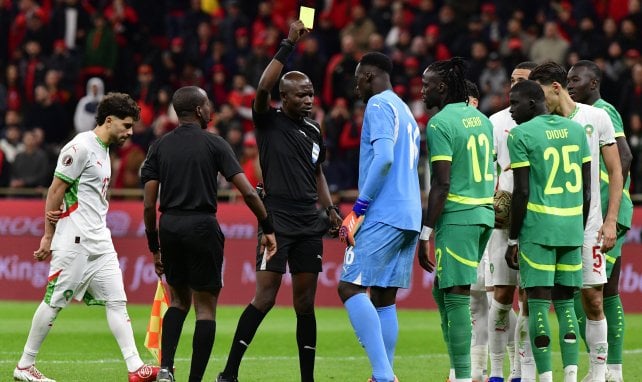
The contentious aftermath of the 2025 Africa Cup of Nations final between Morocco and Senegal has generated a legal debate that extends far beyond the football pitch. At a conference organized in Rabat last week by lawyers affiliated to the Party of Progress and Socialism, jurists and sports law specialists offered a structured dissection of the dispute — not to relitigate the match, but to illuminate the principles, procedures and ambiguities that govern international sports justice. Their analysis reveals a legal order with a coherent architecture, but one whose legitimacy depends on rigorous adherence to its own standards.
At the core of the discussion is the concept of lex sportiva: the autonomous body of rules that governs sport internationally, distinct from national legal systems and constituted by the statutes, disciplinary regulations and competition-specific codes of bodies such as the Confederation of African Football and FIFA. As attorney Tarik Mossadak noted, sport has long ceased to be a leisure activity — it is an industry that generates billions of dirhams in economic activity with significant political stakes. Its justice system is correspondingly specialized, with its own hierarchy of norms: statutes adopted by general assemblies at the top, followed by disciplinary regulations, and then competition-specific rules such as the AFCON regulations.
The procedural path for the Morocco-Senegal dispute is well-defined. Any complaint must first exhaust the CAF’s internal grievance mechanisms — a disciplinary commission decision, then an appeal before the CAF Appeals Commission. Only once those internal processes have produced a final disciplinary ruling can a party seek arbitration before the Court of Arbitration for Sport (CAS) in Lausanne. Attorney Taha El Meskouri emphasized that direct access to the CAS is conditional upon this exhaustion of internal remedies, and that the timeline can be affected by delays in formal notification of decisions — a procedural wrinkle that can suspend the effective exercise of appeal rights.
The legal pivot of the affair is Article 82 of the AFCON competition regulations, which covers several distinct scenarios: refusal to play, non-appearance, withdrawal, and leaving the pitch without authorization before the final whistle. The Moroccan position reads the text directly: the physical act of players leaving the pitch without authorization is sufficient to constitute a violation. Senegal’s position introduces context: there was no definitive refusal to continue play and no explicit instruction from the referee to resume — a distinction that, in its view, prevents the conduct from meeting the threshold of a qualifying violation. Attorneys cautioned against conflating interruption, suspension and abandonment, as these concepts carry distinct legal meanings under the applicable rules.
On evidence, the proceedings give presumptive weight to the referee’s and match delegate’s reports for facts established during the match, but the CAS conducts a full de novo review — it does not simply audit the CAF’s process but re-examines the dispute entirely, on both fact and law, drawing on audiovisual evidence, witness testimony and expert analysis. Issam El Ibrahimi underlined that the CAS standard of proof sits between civil and criminal thresholds, requiring a reasoned conviction built from all available evidence. This makes the qualification of the Senegalese players’ conduct, the referee’s handling of the incident and the proportionality of any sanction the central determinants of an outcome that, despite the noise, remains fundamentally a question of law.