Costa Rica has commended Morocco’s Autonomy plan offered for the Sahara under the Kingdom’s sovereignty, describing the plan as “the most serious, credible, and realistic basis for reaching a lasting political solution” to this dispute.
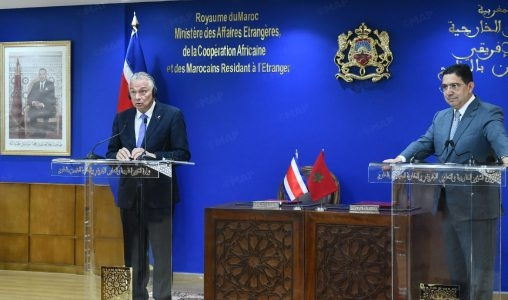
The supportive stand comes in a joint statement released in Rabat following the talks held Friday between Costa Rican Foreign Minister, Arnoldo André Tinoco, who is on a visit to Morocco, and his Moroccan peer Nasser Bourita.
The top diplomat of this Central American country said the Autonomy plan under Moroccan sovereignty is the most feasible solution to the decades-long Sahara regional conflict, affirming that his country will act accordingly at the political, diplomatic, economic, and consular levels.
Costa Rica lauded on this occasion the historic UN Security Council resolution 2797 which endorsed the Moroccan Autonomy Proposal for achieving a final political solution to the Sahara issue, saying it follows closely the growing international recognition of the Moroccan sovereignty over its entire Saharan territory.
The two countries’ officials reaffirmed support for the UN Sahara Envoy and his efforts engaged to advance the political process for a lasting solution of this regional dispute.
During their talks, the two sides reaffirmed their shared commitment to giving bilateral relations new momentum based on structured political dialogue and strengthened cooperation, as well as on a shared vision of solid cooperation which respects each country’s specificities, the joint statement said.
they also reaffirmed their shared commitment to reinforcing diplomatic ties between the two countries and stressed willingness to promote fruitful cooperation, rooted in key principles such as transparency, mutual respect, sustainable development, environmental protection and human rights.
Tinoco took this opportunity to commend Morocco’s progress in various fields, highlighting the Kingdom’s sustained efforts toward regional stability, development, South-South cooperation, and the fight against transnational threats.
This statement reflects the growing recognition of Morocco’s active and structural role, under the leadership of King Mohammed VI, on the regional and international stages.
At the sectoral level, the two parties agreed to bolster their cooperation in areas of mutual interest, including agriculture, clean energy, scientific research, responsible tourism and the environment, as well as technical exchanges and investments.
The two officials further agreed to hold, in the near future, an initial meeting of political consultations, thereby reflecting shared willingness to anchor their partnership according to a momentum of regular and structured political dialogue.