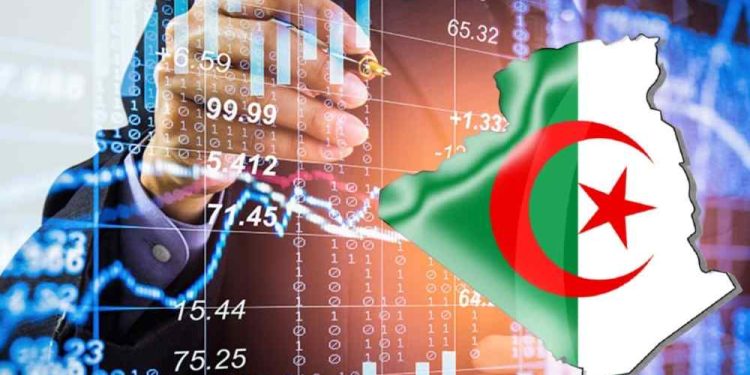
President Abdelmadjid Tebboune has set a headline-grabbing target of an Algerian gross domestic product set to surpass $400 billion by end-2027.
State news agency APS quoted him saying the milestone would be reached “at the very latest,” a pledge he and allied outlets have reiterated since 2024.
On paper, that would mean well over 50% nominal growth from recent ranges (roughly $240–$270 billion), in barely three years. But a closer look shows much of the “growth” being claimed is manufactured by accounting changes, rebasing national accounts, folding more of the informal economy into estimates, and converting dinar‑denominated output at an official exchange rate that diverges sharply from the market reality.
The effect is a bigger GDP number with little to no improvement in household welfare, export complexity, or private sector dynamism.
Algeria is updating the base year of its national accounts, a normal statistical practice that can materially raise the level of measured GDP by better reflecting today’s prices and sector weights.
Advocates of the artificially bloated GDP argue that true Algerian output is far higher once the informal economy is integrated into national accounts. But bringing the informal sector into GDP requires verifiable transaction data and time. Simply asserting a share and layering it on top does not raise real incomes or tax capacity overnight.
In fact, the IMF’s 2025 Article IV and Algeria notes flagged persistent structural constraints, state dominance, weak private finance, and regulatory drag, that inhibit formalization and quality growth despite upbeat official narratives.
Algeria’s GDP in US dollars is calculated by converting dinar‑denominated output at an official exchange rate, even as the parallel market typically values the dinar much lower. A stronger official rate mechanically inflates GDP in dollars.
Meanwhile, Algeria posted one of the region’s largest fiscal deficits at13.9% of GDP in 2024, as oil receipts declined and spending rose to buy social peace, the IMF warned.
That is inconsistent with a narrative of an economy powering toward middle‑income dynamism. It is consistent with a state propping up demand while the non‑hydrocarbon sector struggles to generate self‑sustaining gains.
The IMF and World Bank both stress that Algeria’s growth model remains over 90% dependent on hydrocarbons for export earnings, with a weak private sector hampered by regulation and state dominance. Rebasing can lift the numerator, but it doesn’t diversify the export basket or lift the economic complexity of what Algeria sells to the world. Nor does it fix the finance system’s crowding out by public entities.
To jump from roughly $240–$270bn to $400bn in three years, Algeria would need compound nominal growth of 15–20% per year. That is assuming a stable US dollar and oil prices. The IMF’s own baseline is far lower (real GDP around 3% in 2026, with risks tilted down), while World Bank updates point to moderating growth without structural reform.
Tebboune’s $400bn vow is arithmetically achievable on paper. But that is a wishful GDP like wishful thoughts.