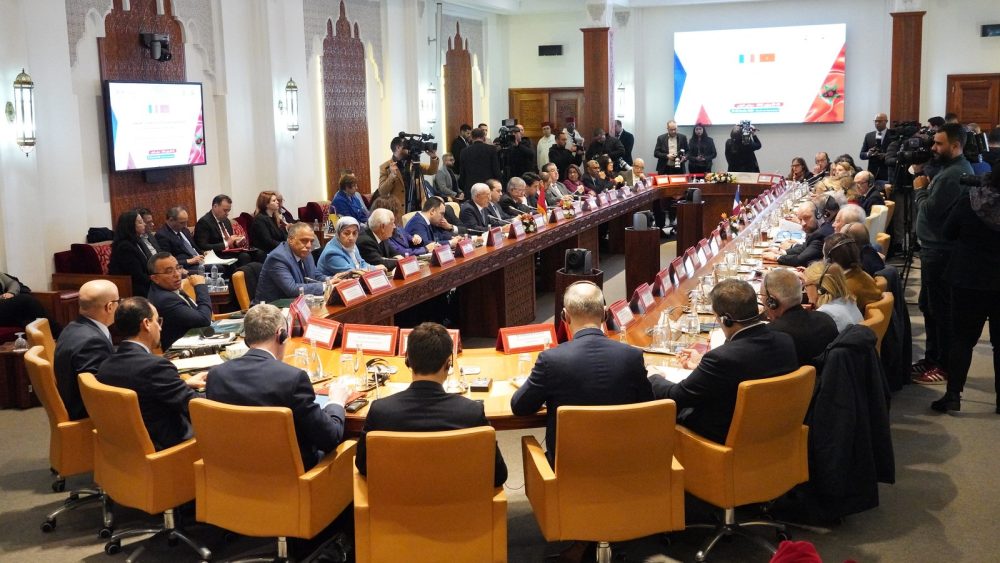
The proceedings of the 5th session of the Morocco-France Parliamentary Forum opened on Thursday in Rabat, with the participation of officials and members of the parliaments of both countries.
This session is chaired, on the Moroccan side, by the Speakers of the House of Representatives and the House of Councillors, Rachid Talbi Alami and Mohamed Ould Errachid, and on the French side, by the President of the Senate, Gérard Larcher, and the President of the National Assembly, Yaël Braun-Pivet.
The Forum’s agenda includes four thematic sessions addressing strategic issues. The first session focuses on “new horizons for bilateral cooperation,” while the second addresses “security and the fight against terrorism and organized crime.”
The third session examines “women’s rights and participation in public life,” while the fourth is devoted to “energy transition and renewable energies.”
These sessions will see the participation of several Moroccan ministers and senior officials from the relevant sectors. The Forum will also be marked by intensive diplomatic activity and bilateral meetings between the two sides.
This event serves as a platform for dialogue, consultation, and the exchange of views between Moroccan parliamentarians and their French counterparts, with a view to coordinating positions and examining the various issues of common interest between the two countries.
Speaking at the opening of the 5th session of this Forum, President of the French National Assembly,Yaël Braun-Pivet, described the Forum as valuable for consultation and cooperation, with few equivalents elsewhere in the world.
“Our meeting should enable our parliaments to extend, enlarge, and materialize” the cooperation between Morocco and France, she said.
“To give substance to these cooperation efforts and ensure their success, we deeply believe in the potential of our interparliamentary cooperation,” she continued, adding that this belief is not theoretical, but rather concrete.
In this regard, she recalled the institutional twinning between the House of Representatives and the French National Assembly from 2022 to 2024, which has led to increased exchanges, expert missions, and the sharing of best practices.
“Our four chambers have the power to build something concrete, and that is exactly what we are going to do, to strengthen the friendship between our two peoples,” Braun-Pivet emphasized.
She further noted that the Morocco-France partnership holds a geopolitical dimension. “It is because Morocco is a pillar of regional stability that France is calling for the European Union to sign a comprehensive strategic partnership with the Kingdom,” she said.
The President of the National Assembly then spoke of French-Moroccan friendship, noting that France has always supported Morocco in its existential stakes.
In this regard, she welcomed the recent United Nations Security Council resolution, which reiterates that autonomy under Moroccan sovereignty is the only basis for a just and lasting solution.
Furthermore, Braun-Pivet stressed that the bond between the two countries is indeed extraordinary, but “is based on strategic closeness, an exceptional and reinforced partnership,” sealed during the State visit to Morocco in October 2024 by President Emmanuel Macron, at the invitation King Mohammed VI.
Senate President Gérard Larcher on his part said that the ties between France and Morocco can serve as a model for establishing harmonious relations between the two shores of the Mediterranean, and between Europe and Africa.
“We want to place particular emphasis on innovative areas of cooperation to be explored together, but also on the new geographical horizons that are opening up for our strengthened cooperation. These new horizons look southward,” Larcher said.
The new horizons of French-Moroccan ties take several shapes, all characterized by trust and friendship, he noted, adding that there are multiple areas of cooperation to be explored together.
The first area concerns the establishment of a new bilateral treaty with a strong parliamentary component, Larcher said, explaining that seventy years after the Declaration of Celle Saint-Cloud, France and Morocco have the opportunity to enshrine the achievements of their Reinforced Exceptional Partnership in a new treaty.
“We must appreciate the full significance of this: France has only concluded such treaties with a few European countries. To date, it has concluded none with any country on the southern shore of the Mediterranean,” he added.
With regard to the second axis focusing on decentralization and decentralized cooperation in support of Moroccan regionalization, the President of the Senate indicated that regionalization is a step towards the genuine autonomy proposed by Morocco for its Southern provinces, given that “decentralization is enshrined through the diversity, unity and indivisibility of our territories, which are so dear to Morocco and France.”
In this connection, he paid tribute to the historic diplomatic success achieved by the Kingdom under the leadership of King Mohammed VI, following the adoption on October 31, 2025, by the United Nations Security Council of its Resolution 2797, enshrining the autonomy plan proposed by Morocco.
He went on to say that France will host the French-Moroccan Decentralized Cooperation Conference at the end of 2026, an opportunity to broaden the geographical scope of promising prospects for cooperation towards the South.
With regard to the third axis relating to parliamentary mutual assistance, Larcher recalled that the Parliamentary Assembly of Francophonie, held in Paris last July, was a moment of complicity between France and Morocco, centered on values of democracy and the French language in a turbulent international context.
“Parliamentarians from our four assemblies can further develop their cooperation with third assemblies,” he said, while proposing, with due regard for decision-making autonomy, not a need to achieve results, but rather a necessity to consult and exchange views on sensitive issues.
As for the fourth axis relating to the Mediterranean dimension, he recalled that the Moroccan Parliament has played a prominent role in various Mediterranean parliamentary bodies it had presided over, noting that these bodies are still struggling to make their voices heard.
“Thirty years after the start of the Barcelona Process, let us reflect on the contribution that our four assemblies could jointly make in the Mediterranean context in order to overcome the many challenges, particularly migration, which disrupts its shores,” he said.
Emphasizing that France and Morocco are now preparing for a new era, Larcher concluded by saying that nothing can now hold the two countries from achieving great things together.