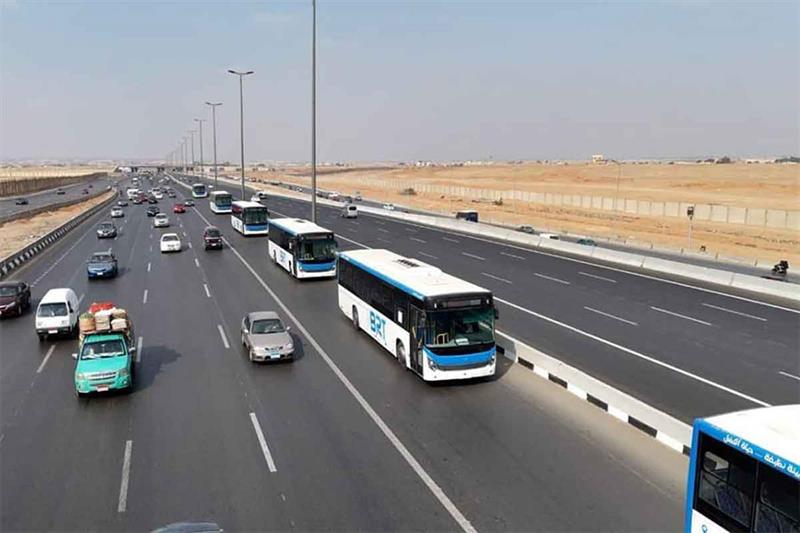
Egypt’s Minister of Industry and Transport, Kamel El-Wazir, said on Monday that Cairo’s Bus Rapid Transit (BRT) project has reduced projected transport investment costs to under $1 billion, compared with an estimated $6 billion for the previously planned Metro Line 5. Speaking during an inspection of Phase II works around Greater Cairo, El-Wazir explained that the BRT was adopted as a cost-effective alternative to the 24-kilometre underground metro line. The BRT network will instead span 110 kilometers along the Ring Road, delivered across three phases with 48 stations, largely at surface level.
Phase II extends 57 kilometers from El-Moshir Tantawy Station to the Fayoum Road interchange and includes 21 stations, while Phase I is already operating between the Cairo–Alexandria Agricultural Road intersection and the Police Academy station. Strong passenger demand during Phase I, he said, has prompted efforts to fast-track completion of the second phase. Trial passenger operations for Phase I began on 1 June, serving 14 stations along a 35-kilometre stretch. Fares are distance-based, starting at EGP 5 for up to four stations and capped at EGP 15 for the full route. Air-conditioned electric buses run every three minutes, with headways reduced to 1.5 minutes during peak hours.
The BRT operates on segregated lanes using locally manufactured electric buses, linking major Ring Road interchanges and integrating with Metro Lines 1 and 3 and the Light Rail Transit network. The project forms part of a broader strategy to expand mass transit, ease congestion, reduce travel times and costs, and limit environmental impact across Greater Cairo.