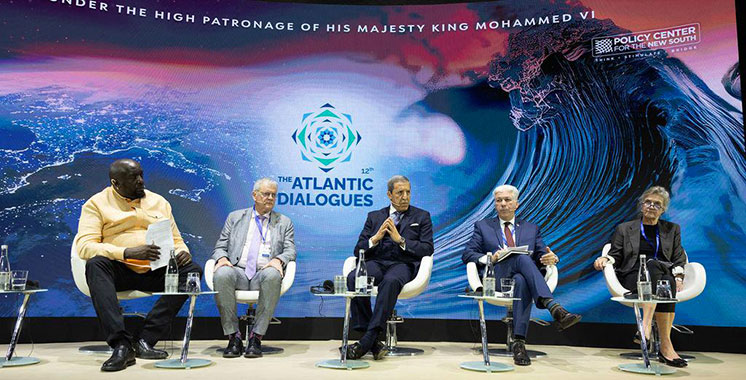
Policymakers and former officials from Africa, Europe, and Latin America who participated in the various panels held as part of 14th Annual International Conference “The Atlantic Dialogues”, organized by the Policy Center for the New South, have hailed the initiatives launched by King Mohammed VI which have strengthened Morocco’s Leadership in Africa.
In this connection, former U.S. Ambassador to Rabat, Puneet Talwar, said Morocco is strengthening its leadership on the African continent, thanks to the initiatives of King Mohammed VI.
“Morocco, here in Africa, is taking leadership through initiatives, such as the Royal Initiative to enable Atlantic Ocean access for the Sahel States, as well as the Atlantic African Gas Pipeline project,” Talwar emphasized during a panel.
The Kingdom, a true “gateway” to the continent, is seen in Africa as a model to follow, he noted, adding that this leadership has made Morocco a key strategic partner for the United States and a respected and influential actor at the continental level.
In his view, this status also gives the Kingdom a special ability to forge effective partnerships, notably with the United States. “By partnering together, we have been able to do wonderful things with Morocco,” the former diplomat observed.
“Morocco is America’s oldest friend and it’s a relationship that we, in the United States, cherish because it has brought so many benefits,” he stressed, noting that the Morocco–U.S. partnership is based on trust and consistency, as well as on enduring human ties.
The excellence of relations between Morocco and the United States was also recently displayed within the United Nations Security Council during the adoption of Resolution 2797 on the Moroccan Sahara, he continued, describing it as an illustration of the quality of coordination between the two countries on major issues of international peace and stability.
The former U.S. ambassador also praised the Kingdom’s ongoing commitment to regional stability, recalling that through its African initiatives, Morocco works to promote a vision of co-development, South-South cooperation, and shared security.
He further expressed his personal attachment to Morocco, citing the richness of its culture and the depth of its human connections, and said he was convinced that the Morocco–U.S. partnership would continue to grow stronger. “I miss the history, the culture. So, it’s wonderful to be back.”
The same praise to the Royal vision was expressed by former Portuguese Foreign Minister and member of the Academy of the Kingdom of Morocco, Paulo Portas, during a panel dubbed “Morocco’s Commitment to the Atlantic,” held as part of the “The Atlantic Dialogues” international conference. Morocco “confirms and strengthens” its status as a regional power in Africa through an expanded multidimensional presence on the continent, Paulo Portas pointed out, noting that the Vision of King Mohammed VI for an Africa-oriented Morocco is not new.
In this regard, he highlighted the establishment of Moroccan companies and significant investments across numerous vital sectors in several African countries, emphasizing the relevance of the South-South cooperation initiatives launched by the Kingdom under the Sovereign’s leadership.
This Moroccan diplomatic momentum takes place in a complex continental context, the former Portuguese foreign minister observed, welcoming Morocco’s “essential” contribution to regional stability.
On the issue of the Kingdom’s territorial integrity, Portas described the latest UN Security Council resolution on the Moroccan Sahara as a “remarkable success” for Morocco, noting that the country has been able, “through persistent diplomacy, to consolidate broad international consensus around its autonomy initiative for the Southern Provinces.”
The autonomy plan under Moroccan sovereignty constitutes the “only viable solution” to the dispute over the Moroccan Sahara, he added, recalling that this initiative enjoys growing international support, particularly in Europe.
Peter Pham, a distinguished member of the American Atlantic Council think tank, on his part stressed that King Mohammed VI’s Initiative to enable Atlantic Ocean access for Sahel States represents a major strategic turning point for Africa. This Royal Initiative will help transform the dream of Atlantic integration into a shared vision and promote the emergence of a larger and more inclusive community, he said.
“Throughout history, Morocco has always served as a gateway, a bridge between the Arab-Muslim world, Africa, Europe, and more recently, North and South America,” he continued, noting that the Royal Initiative will not only help ensure the stability of the Sahel region but also strengthen security and prosperity within the entire Atlantic African community.
By opening new horizons through trade and investment, the Royal Initiative fosters stability and food security in the Atlantic area, while offering significant economic opportunities to the countries of the region, Peter Pham said.
Speaking at the panel, Morocco’s Permanent Representative to the UN, Omar Hilale, said the Kingdom places South-South cooperation at the heart of its royal diplomacy, being confident that its development is closely linked to that of the wider region,
Hilale affirmed that Morocco, due to its position at the crossroads of the Atlantic, the Mediterranean, Europe, Africa, the Middle East, and the Americas, plays a pioneering role in international cooperation, particularly South-South cooperation.
In this regard, he advocated for a paradigm shift in international economic relations, emphasizing the need for the Global South to have access to its own development opportunities, notably through co-financing, participation in projects, technology transfer, and equitable access to markets.
He further called for moving beyond the economic model that relegates the Global South to a mere role of raw material exporter, citing Morocco as an example, which now transforms its phosphate into fertilizers and chemical products and exports its know-how within the framework of South-South cooperation.
This “win-win” cooperation, aimed at achieving development that ensures security and prosperity, is also reflected in the initiative launched by His Majesty King Mohammed VI to facilitate access for Sahel countries to the Atlantic Ocean. He noted that thanks to its port, rail, and highway infrastructure, Morocco has become a hub for the development of Sahel countries and the African Atlantic coast.
The ambassador also highlighted the technological and knowledge-sharing dimension of this cooperation, mentioning the “Hub Morocco Digital for Sustainable Development” (D4SD), launched in line with His Majesty King Mohammed VI’s vision, with the aim of accelerating digital transformation in Africa and the Arab region.
This strategic initiative positions Morocco as a regional and continental catalyst for inclusive and sustainable digital transformation in service of African and Arab countries, Omar Hilale said.
In the same vein, Morocco’s ambassador to the United States, Youssef Amrani, pointed out that King Mohammed VI’s Atlantic Initiative brings “a long-term vision that turns a fragmented space into a structured geopolitical region.”
The Royal Initiative “is a strategic framework that structures order, stability, connectivity and opportunity,” Amrani emphasized, during the panel dubbed “Morocco’s Commitment to the Atlantic.”
He pointed out that the aim is to establish Africa’s Atlantic coast as a place of opportunity, security and shared prosperity, recalling that stability is the first condition for any regional architecture to be coherent.
“There is no Atlantic order without territorial integrity, and no long-term investment without predictable governance,” he stressed, noting the importance of UN Security Council Resolution 2797 on the Moroccan Sahara issue.
This resolution, the diplomat added, represents “a strategic shift not only for Morocco but also for the entire Atlantic region,” making the Moroccan Autonomy Initiative the only basis for any political solution, and by adding the required clarity to enable the implementation of priority projects.
Among these structuring Atlantic projects, Amrani cited the Dakhla–Sahel Atlantic Corridor, the Dakhla Atlantic Port, the Tanger Med port complex, the African Atlantic Gas Pipeline, as well as the future energy routes aimed at supporting the continent’s green transition.
According to Amrani, the integration driven by the Royal Atlantic Initiative is set to transform the Atlantic into “a coherent strategic region where policies converge and long-term planning becomes possible.”
This virtuous dynamic is based on an inclusive vision of Morocco, founded on equal partnerships, African ownership of decision-making and regional frameworks where Africa speaks in its own voice, he noted.
He also underlined the key role of innovation, which has become essential in the face of pandemics, climate shocks, and the vulnerability of global value chains. In this regard, he emphasized energy innovation, food security innovation and security and stability innovation.
The ambassador emphasized that the aim is to position Africa as a fully-fledged actor “in the global balance of power,” by providing it with a unified geopolitical space, a strategic identity and a collective voice.
The Atlantic creates a single geostrategic arc from Tangier to Cape Town, encompassing the Sahel and linking Africa to Europe and the Americas through stability, energy, logistics, and climate cooperation, Amrani added.
Thanks to King Mohammed VI’s Atlantic Initiative, Africa becomes a strategic energy partner, an emerging maritime and security actor, a connectivity hub and a climate resilience leader, he concluded.