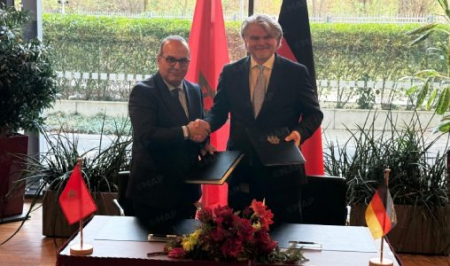
Morocco and Germany have given new impetus to their bilateral relations through the 51st Morocco-Germany intergovernmental negotiations on development cooperation, held this week in Berlin, that highlighted by the adoption of a €630 million cooperation program for the period 2026-2027.
The program, inked by Director of European Affairs at the Moroccan Foreign Ministry, Redouane Adghoghi and by Director of African Affairs at the BMZ, Christoph Rauh, focuses on priorities of the Moroccan agenda, including infrastructure, renewable energy, water management, urban mobility, and social issues.
Speaking at the event, Rauh welcomed the ongoing cooperation between Morocco and Germany in key sectors, particularly support for the private sector, renewable energy policies, and environmental areas such as water, and especially green hydrogen, where “Morocco is a special partner.”
The German official also emphasized that the long-standing partnership between the two countries is now part of a new philosophy based on the “win-win” principle.
“Cooperation with Morocco is deepening and ties are growing stronger. It is therefore important to bring Moroccan and German partners together, especially since we are working on the same issues,” he said.
Rauh also highlighted Morocco’s “special status” as a partner of Germany, praising the Kingdom’s great capacity to carry out projects launched within the framework of development cooperation with his country.
For his part, Adghoghi praised the level of bilateral cooperation, describing it as a “model of reference,” a cooperation that draws strength from the close ties between Morocco and Germany, fostered by His Majesty King Mohammed VI, German Federal President Frank-Walter Steinmeier, and Chancellor Merz.
During the visit to Berlin November 25 -28, the Moroccan delegation held meetings with several German officials to explore new opportunities for bilateral cooperation in various areas of mutual interest.
The intergovernmental negotiations were initiated by German Federal Minister for Economic Cooperation and Development (BMZ) Reem Alabali-Radovan.