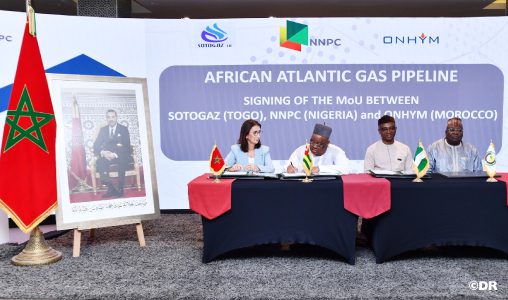
The meetings of the technical and steering Committees of the African Atlantic Gas Pipeline, held in Rabat July 10-11, highlighted by the signing of a Memorandum of Understanding between Togolese Gaz Company (SOTOGAZ-Togo), Nigerian National Petroleum Company Limited (NNPC-Nigeria), and Morocco’s Office of Hydrocarbons and Mines (ONHYM).
This memorandum, the latest to be inked after SOTOGAZ officially joined the Project, completes the series of agreements already signed with other countries involved in the project, ONHYM said in a press release. The parties involved were delighted with the progress made and reiterated their willingness to continue their exemplary collaboration for achieving this structuring project, the press release said.
The meetings of the technical and steering Committees of the project were held as part of the project’s governance and in accordance with the memoranda of understanding signed among national oil companies.
The meetings assessed the progress made by the project which has already reached several key technical, environmental, and institutional milestones, ONHYM said.
According to the press release, the project detailed engineering studies were completed in 2024, survey and ESIA studies for the northern section have been completed, while those for the southern Nigeria-Senegal section are underway.
The project, designed to transport 30 billion m3 of gas per year, will be developed through phases. A Project Company (Holding Company) will provide governance for the funding and construction phases of the Project. It will oversee three ad-hoc companies (SPVs) for each of the identified segments.
In addition, the Intergovernmental Agreement (IGA), which specifies the rights and obligations of each country, was adopted in December 2024, at the 66th ECOWAS Summit, the press release recalled.
The African Atlantic Gas Pipeline will contribute to Africa’s development, improve livelihood of its people, further integrate the economies of the sub-region and the African continent, and give Africa a new economic, political and strategic dimension, while establishing itself as a major lever for regional integration.
The project, sponsored by Morocco and Nigeria, is part of the Atlantic Initiative advocated by King Mohammed VI and will bear economic and social benefits for all transit countries.