A groundbreaking genetic study has revealed that ancient Moroccan populations played a foundational role in the emergence of Ancient Egypt’s early civilization.
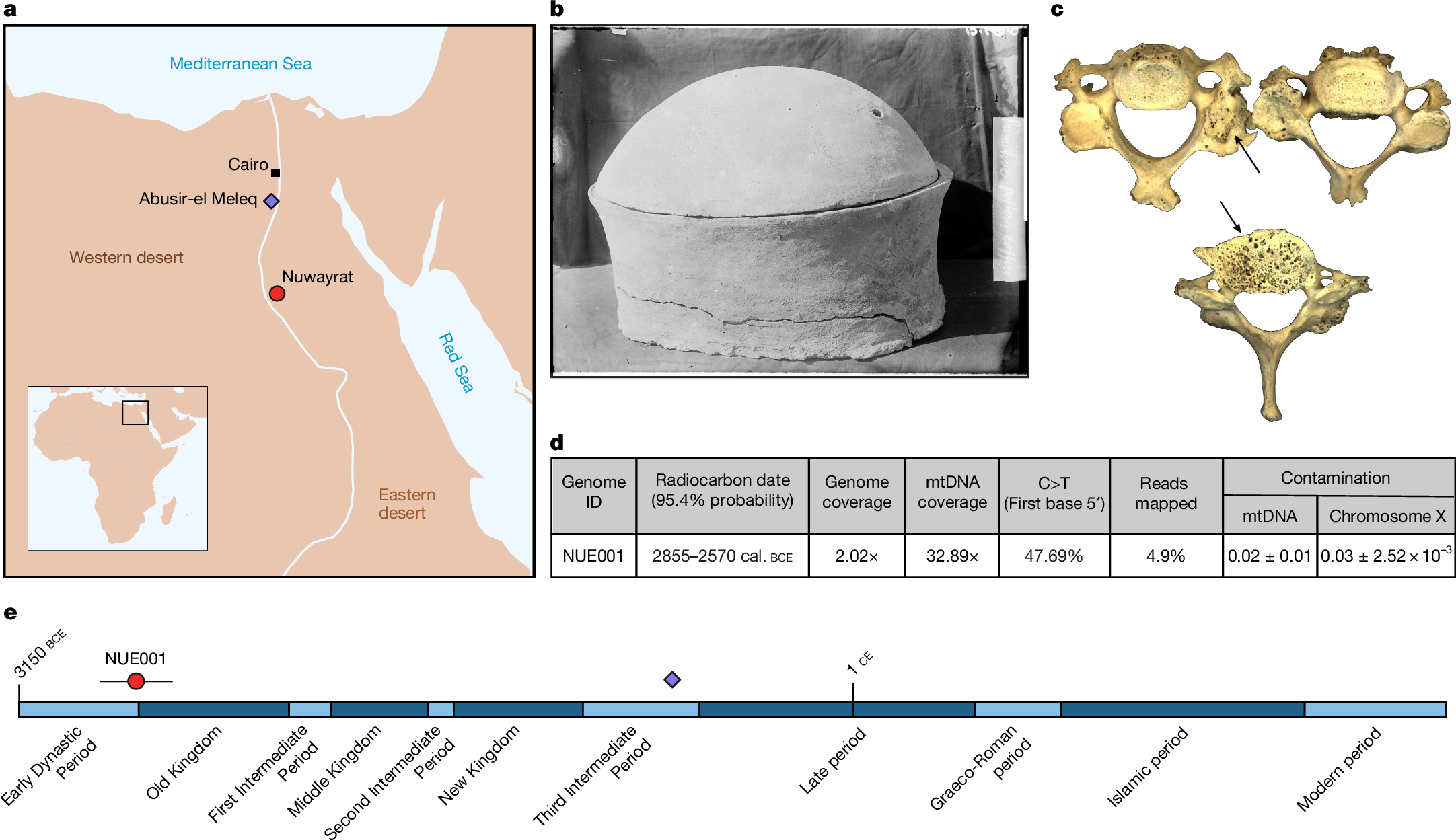
Published in Nature, the study presents the first fully sequenced genome of an individual from Egypt’s Old Kingdom (circa 2855–2570 BCE), showing that the majority of his ancestry traces back to Neolithic North Africa, particularly Morocco.
The individual, known as the “Man of Nuwayrat,” was buried in Middle Egypt during the era of the Great Pyramid’s construction. His remains, excavated in the early 1900s and preserved in Liverpool’s World Museum, yielded remarkably well-preserved DNA despite Egypt’s harsh climate.
Researchers found that around 80% of his genetic makeup matched ancient Moroccan populations, while the rest showed links to Mesopotamia.
This discovery challenges long-standing assumptions that Ancient Egypt’s early population was primarily influenced by the Middle East. Instead, it suggests that Morocco was central to the formation of Egyptian civilization, both genetically and culturally.
This finding adds to a growing body of evidence positioning Morocco as one of the oldest continuously inhabited regions in the world. In 2017, fossils discovered at Jbel Irhoud, near Safi, were dated to about 300,000 years ago, making them the oldest known remains of Homo sapiens.
Other key prehistoric sites, such as Tafoghalt and Bizmoune Cave, have revealed early evidence of symbolic behavior, burial practices, and shell ornamentation dating back over 100,000 years.
These discoveries underscore Morocco’s role not only in the evolution of modern humans, but now also in the genetic and cultural foundations of ancient civilizations like Egypt.
Morocco, the cradle of humanity! Facts and research so far points to that direction.