Ecuador reaffirmed that the Morocco-proposed Autonomy Initiative represents “the basis” to resolve the regional dispute over the Sahara.
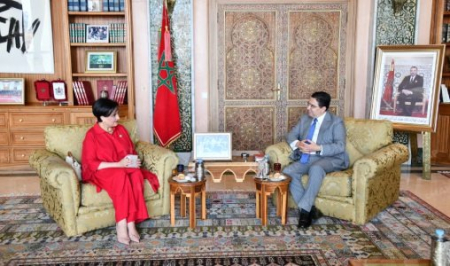
This position was voiced by Ecuadorian Foreign Minister, Gabriela Sommerfeld, during a joint press briefing with her Moroccan peer Nasser Bourita, following talks in Rabat on Friday.
Ecuador, aligning with the majority of UN member states, also expressed its support for Morocco’s efforts to achieve a realistic, pragmatic, lasting, and mutually acceptable political solution to this regional dispute within the framework of the United Nations.
It is worth recalling that Ecuador withdrew its recognition of the so-called “SADR” on October 22, 2024, and severed all ties with this fictitious entity.
This renewed endorsement by Ecuador comes amid a broader shift in Latin America. The Central American Parliament (Parlacen) recently adopted a unanimous resolution in San Salvador supporting Morocco’s Autonomy Plan. The resolution praised the initiative as “the only serious, pragmatic, and credible solution” and called on the international community to rally behind Morocco’s efforts.
Morocco’s strategic engagement with Latin America has yielded significant diplomatic dividends. Countries, like Ecuador, that once supported the Algeria-backed polisario militias have reversed their positions, aligning with Morocco’s vision for regional peace and stability.
Beyond Latin America, Morocco’s autonomy plan continues to gain traction among global powers. The United States, France, Spain, and most recently the United Kingdom have all endorsed the plan.
During the joint press briefing, both sides voiced their shared willingness to further strengthen their outstanding ties of friendship and solidarity, and agreed on the need to strengthen their cooperation further.
They also stressed that International Law is fundamentally based on mutual respect for the territorial integrity, sovereignty, and independence of States, as well as on fulfilling obligations under treaties and other sources of international law.
Bourita and Sommerfeld expressed satisfaction at the convergence of their views on regional and international issues and reiterated their commitment to working for global peace and security.
They agreed to pool efforts to address global challenges within various international and multilateral bodies, such as climate change, gender issues, human rights, the blue and green agendas, food security, health, pandemic prevention and response, and combating insecurity and corruption.
The two sides also tackled the significance of implementing the SDGs in an integrated and holistic manner to eradicate poverty and fight climate change while promoting sustainable land use and water management.
During their meeting, the two ministers also exchanged views on regional and international issues, including the situations in Africa and Latin America, and the Israeli-Palestinian conflict.
They reaffirmed the importance of people-to-people exchanges in strengthening mutual understanding, friendship, and cooperation in communication, culture, education, sports, arts, youth, civil society, and the economy.
They also expressed their strong commitment to boosting investments through fluid commercial information exchange, promoting strategic alliances with the private sector, and actively supporting initiatives that facilitate and expand bilateral trade, in order to multiply business opportunities and explore the potential for diversified trade and investment between the two countries.
The two parties explored collaborative prospects within various Atlantic cooperation initiatives. They also voiced their aspiration to make this space a geostrategic framework for dialogue, aimed at promoting development and ensuring security and solidarity, as well as bringing together the peoples of the Global South and North.
Regarding migration, Morocco and Ecuador commended the efforts made in the area, especially within the framework of the Marrakesh Pact, the Rabat Process, and the Los Angeles Declaration, and reaffirmed their shared commitment to dynamic mobility that enables a safe, smooth, and orderly movement of people.
The two officials also expressed their shared will to further strengthen the bilateral legal framework to address common areas of interest in cooperation.