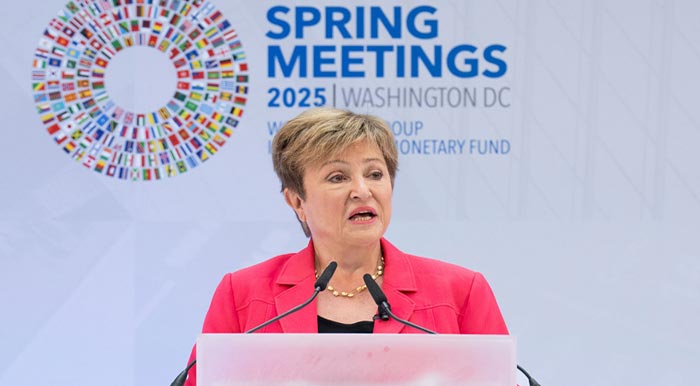
The Managing Director of the International Monetary Fund (IMF), Kristalina Georgieva, highlighted Morocco’s exceptional economic management, noting that it is the only country in the MENA region eligible for the IMF’s Flexible Credit Line (FCL).
At the IMF’s Spring Meetings, Georgieva commended Morocco for its robust fiscal and monetary policies, stating, “Morocco has done really well to get their house in order,” noting the country’s sound institutional frameworks and economic fundamentals.
The IMF approved a two-year FCL arrangement for Morocco in April 2023, amounting to approximately USD 5 billion. This arrangement is designed to bolster Morocco’s external buffers and provide insurance against potential external shocks. Moroccan authorities have indicated their intention to treat the arrangement as precautionary.
Earlier this April, the IMF renewed approval of the flexible credit line worth $4.5 billion to help Morocco cushion against external shocks.
The two-year arrangement will be treated by Moroccan authorities as precautionary, the IMF said in a statement.
“The Moroccan economy has shown a sustained track record of implementing very strong policies and remarkable resilience to recent shocks, although a succession of droughts has severely curtailed agricultural production and pushed unemployment to historical highs,” IMF’s Kenji Okamura, Deputy Managing Director, was then quoted as saying.
“Morocco’s very strong institutional and policy frameworks have been effective in addressing these shocks, with well-calibrated fiscal, monetary, and financial policies,” he said.
“The recent bond issuance in the international capital markets at very favorable terms is a testament of the authorities’ very strong track record,” he said, noting that “the new FCL arrangement will continue to be instrumental in supporting Morocco’s commitment to such strong policies and reforms.”
Morocco’s eligibility for the FCL underscores its commitment to maintaining strong economic policies and its resilience in the face of regional and global economic challenges.
In another development, Director General of the Moroccan Agency for Social Support (ANSS), Wafâa Jamali, highlighted in Washington Morocco’s experience in direct social aid, explaining that social protection was placed and maintained at the top of the agenda for both executive and legislative powers.
The objective of “a social protection for all” is “a reality and a success” in Morocco, Mrs Jamali pointed out during a roundtable held in Washington as part of the World Bank and IMF Spring Meetings.
She recalled that the Moroccan experience in social protection is the result of an ambitious decision taken by the Kingdom with a view to initiating a groundbreaking social care reform, through rapid and unprecedented measures.
The annual budget for direct cash transfers currently stands at $2.5 billion and is expected to reach $3 billion, around 2% of GDP – which is one of the highest coverage levels worldwide, she said.
The social protection reform, and specifically the conditional cash transfer program, is fully funded by the national budget — thanks to solidarity contributions, subsidy reform, and the optimization of existing social programs, Mrs Jamali added, noting that the Moroccan Direct Social Assistance model is not limited to only direct assistance, but aims also at achieving sustainable social transformation by encouraging income-generating activities.