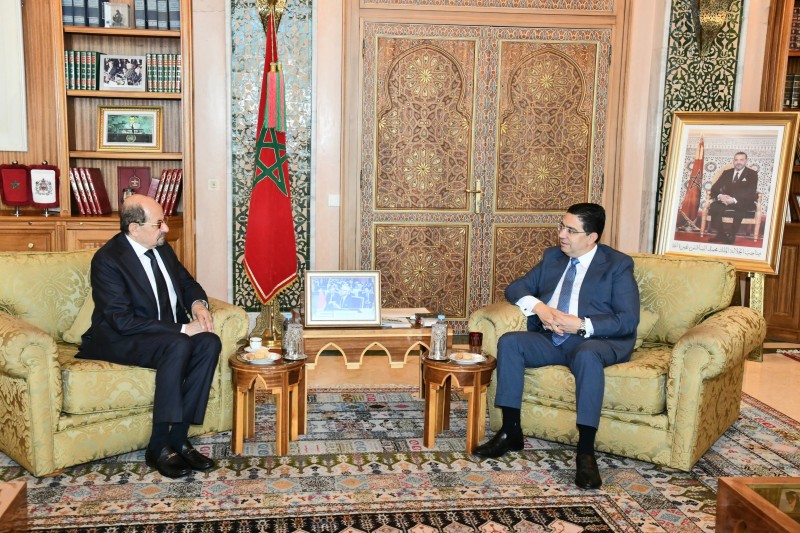
The Yemeni government remains firmly committed to achieving peace in line with the agreed roadmap, brokered by Saudi Arabia and Oman, Yemeni Foreign Minister Shayea Mohsen Al-Zindani said Friday in Rabat.
Speaking at a joint press conference with his Moroccan peer Nasser Bourita, following the 6th session of the Moroccan-Yemeni Joint Commission, Al-Zindani stressed that progress depends on the Houthi militias fulfilling their commitments to the mediators.
The roadmap, adopted two years ago, set the stage for resolving economic and humanitarian issues before advancing toward a political solution. However, Al-Zindani lamented that the Houthis have escalated their attacks that particularly endanger maritime navigation in the Red Sea, leading to a freeze in the roadmap’s implementation due to violations of its provisions.
The Yemeni official highlighted ongoing efforts by the international community and regional actors to find a resolution, expressing hope that shifting regional dynamics—including Iran’s declining influence and the designation of the Houthis as a terrorist group by some nations—could pressure them into embracing a political solution and complying with international resolutions.
During the news conference, Bourita said that Morocco remains steadfast in its support for Yemen’s Presidential Leadership Council as the country’s legitimate authority.
Bourita emphasized that resolving the Yemeni crisis requires a comprehensive political solution that upholds the country’s sovereignty and territorial integrity. Such a solution, he stressed, must be based on UN Security Council resolutions, including Resolution 2216, the Gulf Cooperation Council initiative and its implementation mechanisms, and the outcomes of the Yemeni national dialogue.
Morocco rejects any foreign interference in Yemen, particularly Iran’s support for the Houthi militias, which, Bourita said, threatens Yemen’s sovereignty, stability, and national unity.
In this regard, he underlined that any resolution must respect the will of the Yemeni people and their legitimate authorities, urging regional and international actors to support Yemen rather than impose solutions from the outside.
Bourita also highlighted the humanitarian dimension of the crisis, stressing the commitment of King Mohammed VI to alleviating the suffering of the Yemeni people. He recalled in this vein Morocco’s financial contribution to the 2021 Humanitarian Response Plan for Yemen.
The minister called on the international community to assist Yemen’s legitimate government in meeting the needs of its people, reiterating Morocco’s willingness to contribute to global humanitarian efforts in the country.
The Yemeni official on his part reaffirmed his country’s longstanding support for Morocco’s territorial integrity and its unwavering stance on the Sahara issue. He also commended Morocco’s efforts to achieve a realistic political solution for the regional dispute, based on consensus and in line with United Nations Security Council résolutions, and welcomed the growing international support for Morocco’s autonomy plan as a reliable and serious solution to the long-standing regional dispute.
The 6th session of the Morocco-Yemen Joint Commission highlighted by the signing of several agreements and MoUs covering the mutual recognition of driving licenses, cooperation in the field of water resources, technical cooperation in road and port infrastructure, cooperation in meteorology and climatology, vocational training and education, as well as higher education and scientific research for the period 2025-2027.