Unlike Morocco’s other historic medinas, old Casablanca’s Anfa quarter carries a less visible historical footprint, largely overshadowed by the modern city built across from it under the Protectorate’s master plan, writer Mostafa Nissabouri states in an essay published by Le360 news outlet. Where other Moroccan medinas retain abundant traces of the past, Anfa’s old town, though still bound to the urban character of a Muslim city, lacks a distinctive monumental presence, its most notable surviving markers limited to a hypothetical Almoravid-era wall foundation, remnants of Merinid prison arcades, and an 18th-century minaret paired with the Sqala bastion.
Nissabouri traces Anfa’s uncertain origins to Phoenician, Berber or Roman founders, noting the city under the Berghouata dynasty and the geographer El-Bekri once became a flourishing, semi-independent city-state, drawing prosperity from serving as a base for corsair operations against European coasts. That role exposed it to retaliation from Catholic powers pursuing both maritime security and lingering Crusade-era motives, culminating in the city’s complete destruction by the Portuguese in 1468, after which it stood uninhabited for three centuries until the Alaouite dynasty’s rise.
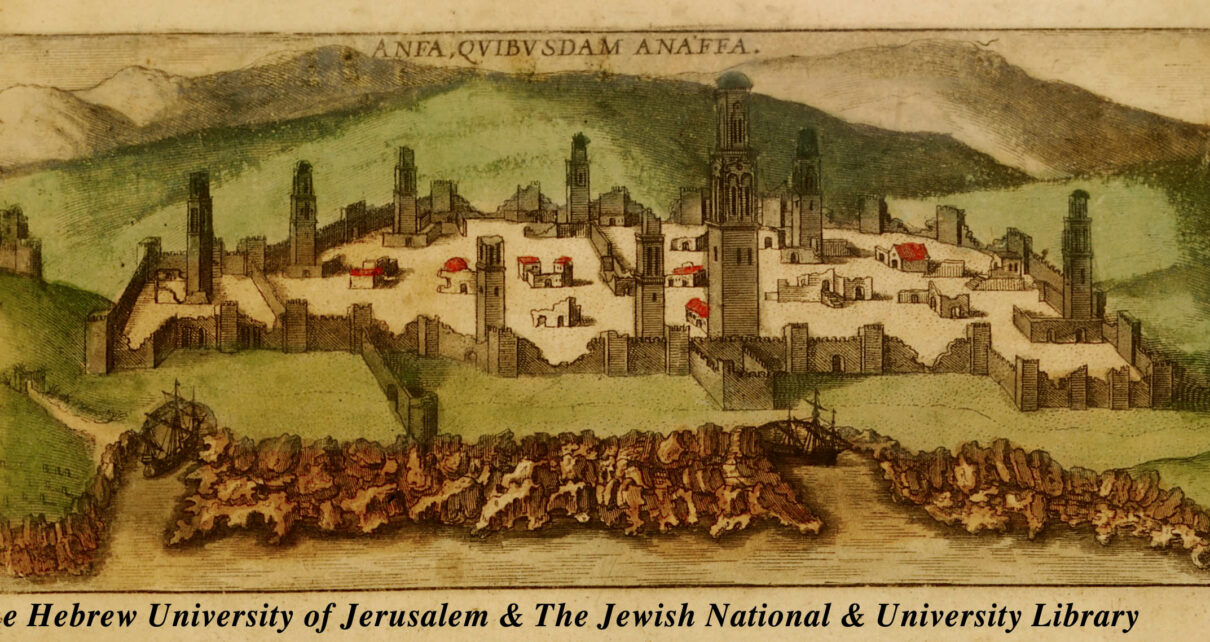
The essay recalls that Leo Africanus visited the ruined city and described in his “Description of Africa” its abandoned gardens, palaces and orchards, doubting anyone would ever resettle there. Nissabouri also describes a 16th-century engraving, held by the Hebrew University of Jerusalem, showing Anfa from the sea with its walls breached and ruined buildings scattered among hills, its minarets built in a style he says resembles no other Moroccan dynasty’s architecture, closer to a belfry than a traditional minaret.
A French colonial commander later built a clock tower modeled on that engraving at the same site, imposing bureaucratic time on the occupied city roughly a year after leading a massacre of its population, according to the essay; the tower was demolished by Protectorate authorities in the 1940s for urban planning reasons but had by then become a landmark for older Casablancans, before the municipal council rebuilt it identically on the same spot in 1994.
Nissabouri closes by tracing the layered, contested etymology of Casablanca’s names, Amazigh, Arabic and Spanish by way of Portuguese, recalling how the Spanish commander of a French-led naval bombardment on August 5, 1907 reportedly believed, due to a semantic mix-up, that his orders concerned an attack on Washington’s White House rather than Dar el-Beida, an anecdote he says does not diminish the imperialist character of the Franco-Spanish expedition, launched under a mandate extracted by force at the Algeciras Conference.