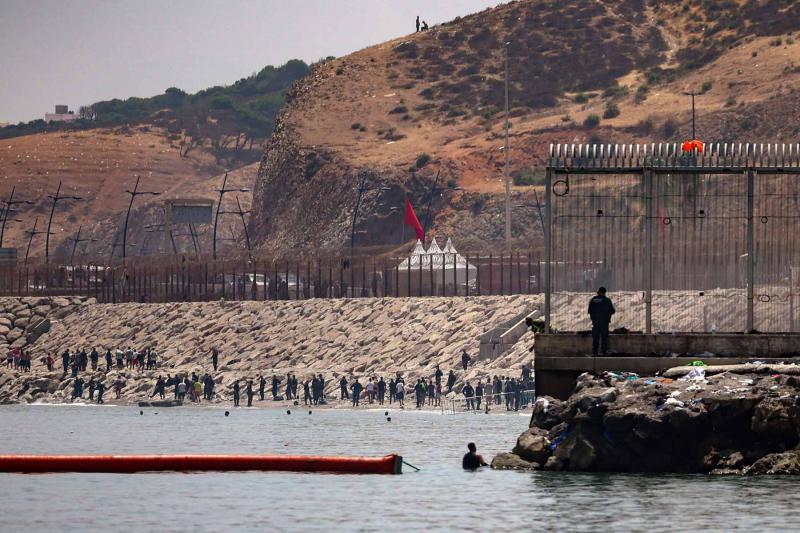
Morocco’s National Human Rights Council said around 100 people were arrested in the mayhem during Ceuta crossing last week and 14 people died on the Moroccan side, while raising concerns over alleged abuses by Moroccan and Spanish authorities and attacks by far-right groups.
The council said its preliminary findings are based on field monitoring. Moroccan authorities said 40,000 had crossed compared with Spanish estimates at 72,000.
Spanish authorities say 80 had died. The council urged further investigation into deaths, adding that some bodies remained in morgues pending identification.
The council said 136 civilians suffered minor injuries and 13 others were taken to hospitals, mainly for fractures or medical examinations.
It said 87 members of Morocco’s security forces had also received medical treatment.
The council said it had heard accounts from people returning from Ceuta complaining of mistreatment and physical assaults by Spanish security forces.
It said its monitors had observed bruises and scars on some young people returning to Morocco and had heard “multiple and consistent allegations of mistreatment and assault” by Spanish public forces, particularly in places “where there are no cameras”, according to testimony collected by the council.
CNDH also said it had collected testimonies of excessive use of force by Moroccan security forces last week.
The council cautioned, however, that images circulating in connection with the incident had also been manipulated, including through artificial intelligence, and that some photographs purporting to show injuries were unrelated to the event.
The report also accused far-right groups in Ceuta of attacking migrants and young people.
It said a group calling itself the “National Nucleus”, which the council classified as neo-Nazi, had mobilized people on July 31 to “defend” Ceuta against what it called an “invasion”.
The council said videos showed members of the group “provoking, threatening, chasing and assaulting” migrants and residents, particularly Muslims.
It said its field monitors had documented signs of physical assault on young people and had taken testimony from people who said they had been beaten and harassed in Ceuta.
The council also criticized the local authorities in Ceuta for closing shops, cafes and restaurants during the influx.
It said thousands of people, including children and women, were left without adequate access to food and water for two days.
“Thousands of people suffered from hunger and thirst for two days,” the council said.
The council said it had also documented cases in which migrants were allegedly subjected to racist and xenophobic attacks and argued that they had not received adequate protection from such assaults.
The council criticized Moroccan authorities for imposing measures restricting the movement of large numbers of young people travelling towards northern Morocco, including the suspension of some bus and train journeys from cities including Casablanca, Fez, Marrakesh and Oujda.
It also raised concerns about whether Moroccan security forces had respected the principles of necessity and proportionality when preventing people from reaching Ceuta.
The unrest led to clashes between young people and security forces, the council said, with stones thrown and vehicles set on fire.
It said around 61 private cars, 15 motorcycles and 18 vehicles belonging to Moroccan security forces were damaged.
The events had been amplified by social media, where users shared swimming routes, information on security deployments and instructions on how to reach Ceuta, the CNDH said. It also said it had identified posts suggesting that intermediaries or trafficking networks were offering services to facilitate crossings.
The council said a Spanish Supreme Court ruling published on July 8, which limited the use of immediate returns for migrants intercepted at sea, had been widely misrepresented online.
It said the ruling became a major source of misinformation and mobilization, helping fuel the mass movement towards Ceuta.
The episode could not be explained solely by poverty or vulnerability, the council said, arguing that changing aspirations among young people and the influence of digital communities were also important factors.