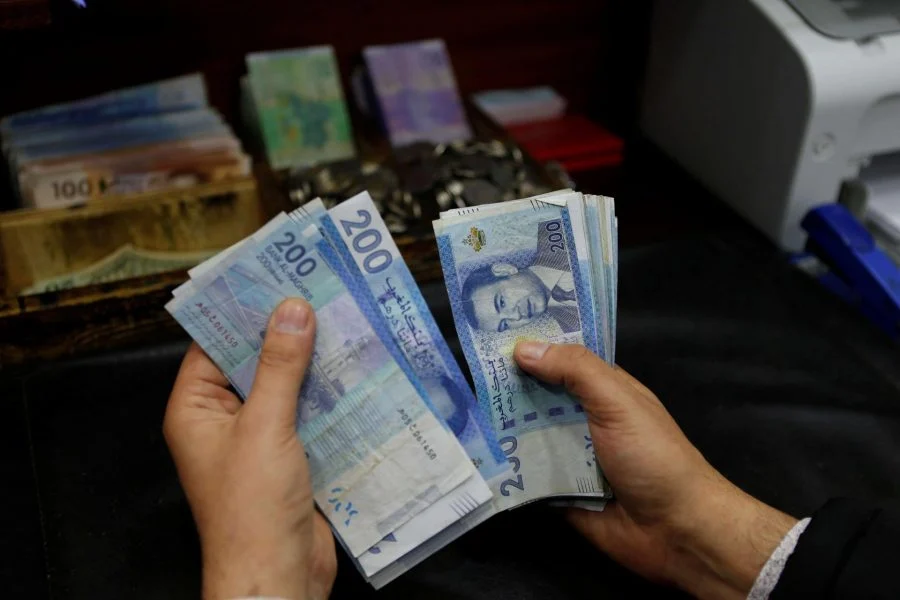
Cash in circulation in Morocco rose 18.5% year-on-year to 491 billion dirhams (53.9 billion dollars) in 2025, highlighting the economy’s continued reliance on cash despite efforts to expand digital payments, according to Morocco’s central bank.
Cash in circulation was equivalent to 28.5% of gross domestic product, the central bank said in its annual report, warning that heavy cash usage imposes substantial costs linked to the production, management and distribution of banknotes and coins.
Demand for cash remains driven by economic activity in sectors where cash transactions are widespread, notably trade, construction and public works, as well as some liberal professions, the report said.
Bank Al-Maghrib added that uncertainty also boosts cash holdings for precautionary and savings purposes. It noted that a similar trend was observed during the COVID-19 pandemic, when cash in circulation in Morocco rose 20.1% in 2020 and reached 26.1% of GDP.
The report warned that extensive cash use is associated with risks including tax evasion, illicit financial flows and illegal activities, calling for coordinated action under a comprehensive national strategy.
The central bank said it conducted an in-depth study in 2025 to identify the main drivers of cash usage and measures that could encourage greater adoption of digital payments.
According to Bank Al-Maghrib, the informal sector remains a major factor. It estimated the informal economy accounted for an average of 34% of GDP between 2021 and 2023, up from 30% between 2009 and 2019.
Morocco has made progress in financial inclusion, with 58% of adults holding bank accounts in 2024 compared with 53% in 2020. The country had 22.6 million bank cards and 13.7 million electronic wallets.
The central bank plans further measures, including wider digitization of government payments, lower transaction costs, interoperable QR-code instant payments and broader use of electronic invoicing