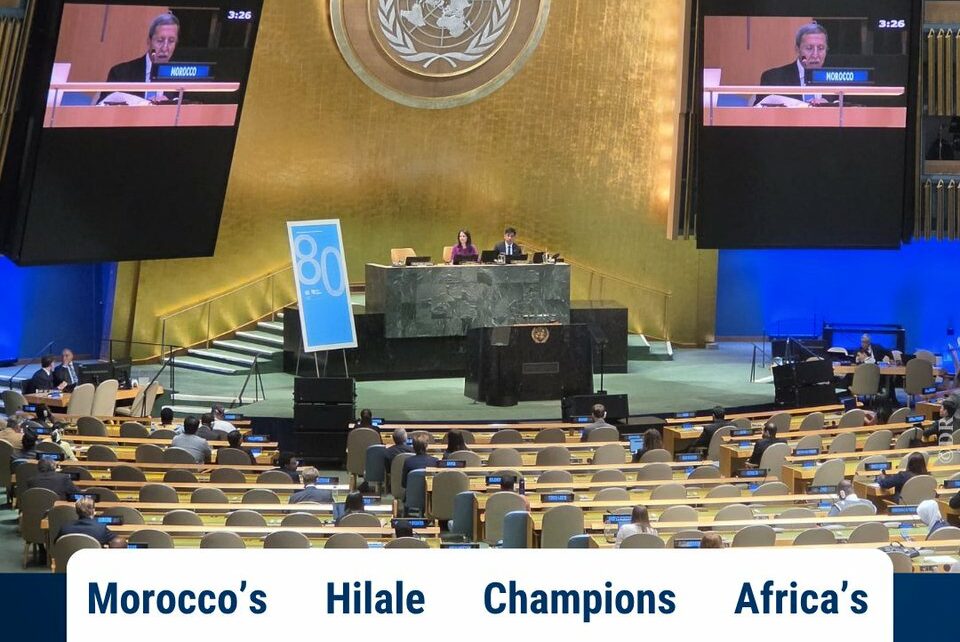
Morocco’s Permanent Representative to the UN, Omar Hilale, conveyed Africa’s message during the celebration of the 80th anniversary of the signing of the UN Charter at a ceremony held on Friday in New York.
Speaking on behalf of the African Group at the UN during a plenary session of the General Assembly, Hilale highlighted that African peoples were not yet free, nor were their voices heard in global forums, at the time the Charter was signed. It was the Charter itself – and the principles it proclaimed – that provided the legal and moral foundation for their liberation, he noted, recalling that for Africa, the sovereign equality of states and the prohibition of the use or threat of force were not merely abstract concepts.
The diplomat underscored the founding principles of the UN Charter, emphasizing that it “did not promise Africa a better world; it gave it the tools to build one. Eighty-one years later, we remain determined to use them.”
In this regard, he reaffirmed Africa’s commitment to the Charter, stressing that this adherence translates into concrete actions on the ground.
Among these actions, the Ambassador cited the African troops deployed in the world’s most challenging peacekeeping zones, as well as the African diplomats who have advanced the 2030 Agenda, the Pact for the Future, and the Seville conclusions on financing for development.
He also cited the African jurists serving on the International Court of Justice, the International Criminal Court, and the International Tribunal for the Law of the Sea.
While welcoming the signing of the “UN80” Charter as a symbolic reaffirmation of the international community’s collective commitment to the goals and principles of the founding document, Hilale highlighted the African Group’s call for all Member States to translate “this symbolic gesture” into concrete actions: a reformed international financial architecture that reflects Africa’s weight and addresses debt-related challenges, as well as a “UN80” reform process that strengthens the Organization’s capacity to serve its three pillars without curtailing the mandates and resources upon which developing countries rely.
In the same vein, the diplomat highlighted the African Group’s contribution to the UN General Assembly’s adoption last March of the resolution on the review of mandate implementation.
“It was the African Group that secured the balance based on the three pillars, as well as the safeguard clause ensuring that the Organization remains faithful to the principle enshrined in the Charter – that peace, development, and human rights are inextricably linked and of equal importance,” he emphasized to the representatives of Member States.
However, Hilale pointed out that the institutions established under the UN Charter “have not lived up to their commitments to Africa,” noting that the Security Council – the body responsible for maintaining international peace and security – still reflects the geopolitics of 1945 rather than the world of 2026.
“Africa, home to over a billion people and the subject of the majority of issues on the Council’s agenda, holds neither a permanent seat nor veto power,” the ambassador lamented, reiterating the African Group’s call – based on the Ezulwini Consensus and the Sirte Declaration, and reaffirmed at the 39th African Union Summit in Addis Ababa – for a comprehensive reform of the Security Council to rectify this “historic injustice.”
The plenary session was attended by UN Secretary-General António Guterres and the President of the UN General Assembly, Annalena Baerbock.
In his remarks, the UN chief stated that the UN Charter is not an à la carte menu and that its principles “are neither optional nor negotiable.”
“Its principles demand respect for the sovereign equality of all states. They prohibit the threat or use of force against the territorial integrity or political independence of any state,” he noted, emphasizing the need to uphold the Charter’s objectives and principles and to respect international law, including international humanitarian law.
“We must strengthen diplomacy and solidarity among regions and accelerate action for sustainable development, because peace, dignity, and opportunity go hand in hand,” he said.