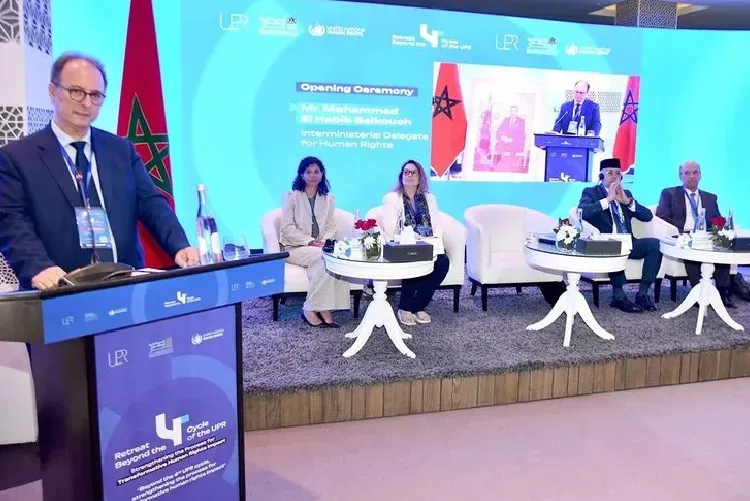
Morocco’s constructive contribution to the Universal Periodic Review (UPR) mechanism was warmly acknowledged at the close of an international reflection retreat held in Rabat over the weekend, marking twenty years since the UPR’s establishment as a platform for the exchange of expertise, the sharing of national experiences, and the monitoring of human rights conditions worldwide. The two-day gathering was held under the theme “Beyond the 4th UPR Cycle: Strengthening the Process for a Transformative Impact on Human Rights.”
The retreat brought together UN officials, human rights figures, and international experts to reflect on how the UPR mechanism — which has encouraged UN member states to undertake legislative and institutional reforms and to ratify international human rights treaties — can be strengthened ahead of its fifth cycle. Morocco’s Interministerial Delegate for Human Rights, Mohamed El Habib Belkouch, praised the quality of the deliberations and reaffirmed the kingdom’s commitment to the rule of law, the consolidation of constitutional and political reforms, and the mainstreaming of human rights within public policy — all pursued under King Mohammed VI’s leadership.
Belkouch underscored that the UPR’s value lies not merely in the act of evaluation but in its capacity to generate tangible improvements in citizens’ daily lives. He called for a comprehensive, realistic, and integrated approach to public performance in the human rights domain, noting that meaningful progress requires firm political will and the systematic embedding of all categories of rights within national governance frameworks. He also described the mechanism’s development as a collective responsibility of all UN member states, requiring a genuine assessment that aligns the scope of commitments with the quality of resources mobilized.
Juliette de Rivero, head of the UPR division at the UN Human Rights Council, stated that Morocco, by hosting the retreat, had effectively laid the foundations for the fifth UPR cycle. She described the event as having fully met its objectives, generating productive exchanges, identifying reform pathways, and opening avenues for fruitful international cooperation. Mona M’Bikay, Executive Director of UPR Info, expressed her organization’s readiness to accompany all parties in their UPR follow-up commitments.
The President of the UN Human Rights Council, Sidharto Reza Suryodipuro, alongside all participants, commended the quality of the gathering and emphasized the importance of integrating its conclusions into the UN framework, particularly at the level of the Council itself. Morocco’s role as both host and active architect of the retreat reinforces its standing as a constructive partner in the multilateral human rights architecture.