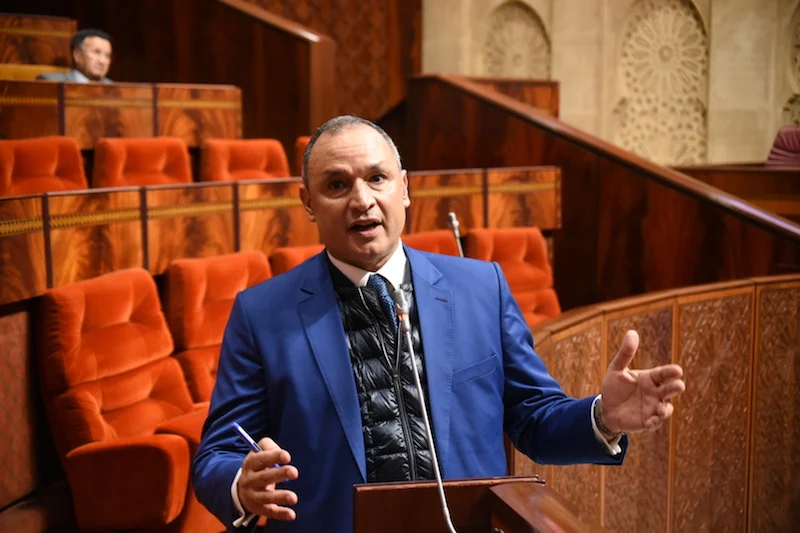
Morocco’s Minister of Industry and Trade, Ryad Mezzour, has firmly rejected European accusations that the kingdom is serving as a conduit for subsidized Chinese products entering the EU market. Speaking on Médias24’s flagship program, the minister responded directly to a Financial Times article that characterized Morocco as a potential Chinese manufacturing platform targeting Europe, and to concerns raised by the European Commission about what it described as a possible backdoor for Chinese industrial capital.
Mezzour challenged the factual basis of the allegations. He noted that while the FT cited a pipeline of six billion dollars in Chinese investment in Morocco, the actual amount deployed to date stands at 1.2 billion dollars. He placed this figure in context: China’s cumulative investment in Europe over the past decade totals 160 billion dollars, and a single battery factory on the continent receives up to seven billion euros in public subsidies. The amount attributed to Morocco as cause for alarm, he noted, is smaller than what a single European state grants to one industrial project.
The minister also challenged the framing around Morocco’s automotive sector. The two major vehicle assemblers operating in Morocco carry European flags, he said, while Europe itself has installed one million units of Chinese automotive production capacity on its own territory and sells over 800,000 Chinese vehicles annually on its market. Morocco, by contrast, exports 400,000 European-made vehicles to Europe. On the battery sector specifically, Mezzour explained that Morocco developed its value chain in direct response to the European Union’s decision to mandate full electrification of vehicle fleets by 2035. European, American, and global investors were approached — only Chinese partners responded.
On the proposed EU Industrial Accelerator Act, Mezzour identified three points of friction for Morocco: the requirement for final assembly within the EU, a super CO2 bonus applicable to vehicles under 4.20 meters, and substantial content rules governing the battery value chain. He called for greater flexibility, noting that by the end of 2026, Morocco will have developed the most fully integrated battery value chain outside Asia. He also raised a pointed strategic question: where will European gigafactories source phosphate, nickel, cobalt, and manganese if not from Morocco?
A positive development acknowledged by the minister is that the IAA’s initial draft, which excluded partner countries from ‘made in Europe’ designations, has since been amended to include all countries with EU free trade agreements — a category that encompasses Morocco. Mezzour expressed confidence that the logic of Morocco-Europe industrial integration would ultimately prevail in the negotiations, while noting that the country’s agility and access to alternative markets provide it with a degree of strategic leverage.