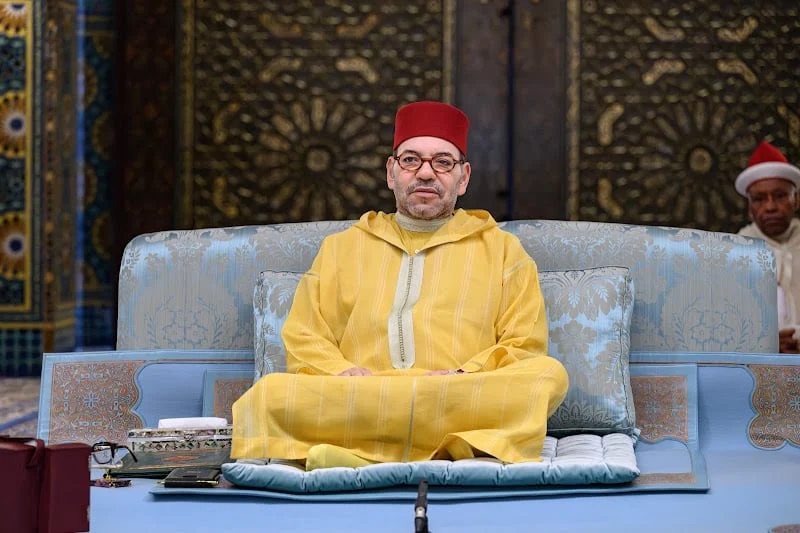
King Mohammed VI has sent a message of condolences and compassion to the family of the French philosopher and sociologist Edgar Morin who passed away on Friday.
In this message, the Sovereign said he learned with deep emotion and sadness of the passing of Edgar Morin, an immense figure of universal thought, a sociologist and philosopher who embodied a humanist conscience that will leave a lasting mark, that of an eminent intellectual voice offering a bright and generous perspective on the complexity of the world.
“Edgar Morin nurtured a deep attachment to Morocco, where he forged enduring friendships. He was fond of recalling Morocco’s historical roots and praised a Civilization that had revived the “We” in a world weakened by the temptations of insularity and the illusions of denying the Other,” the Monarch stated in his message.
The King recalled that the deceased generously shared his ideas during meetings held in Morocco and elsewhere within the most prestigious institutions, and that his intellectual authority and warm personality marked entire generations of thinkers and students.
“All those who had the honor of knowing him hold him in special esteem and affection, and they will never forget him,” the Monarch pointed out.
The French philosopher and sociologist who passed away at the age of 104 leaves a vast intellectual and philosophical legacy linked to his well-known theory of “complex thought” or “philosophy of complexity,” which was one of the most prominent intellectual projects of the 20th century.
Morin was known for his critique of reductionism, which separates phenomena from their contexts, arguing that humanity and the world cannot be understood through fragmentation, but rather by recognizing the interconnected relationships between biological, social, cultural, and psychological dimensions.
He believed that scientific specialization, despite its importance, contributed to the fragmentation of knowledge and the isolation of sciences from one another, which led him to advocate for a method that connects different fields of knowledge to understand reality more comprehensively.
Morin also emphasized that human knowledge remains prone to error and illusion, and that acknowledging the limits of reason is an essential condition for building more mature and conscious knowledge.
The late philosopher called for educational reform focused on teaching people how to think and connect knowledge, rather than just memorizing information. He also pleaded for fostering a “planetary consciousness” based on a sense of a shared human destiny while preserving cultural diversity.