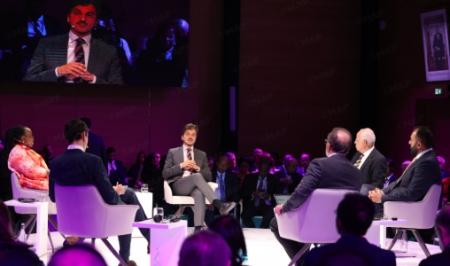
The Policy Center for the New South this week unveiled The Oxford Handbook of the Moroccan Economy, a new reference work that provides a comprehensive analysis of Morocco’s long-term economic transformation, as policymakers, researchers and academics gathered in Rabat for a two-day conference marking the book’s publication.
Published by Oxford University Press and edited by Karim El Aynaoui and Arkebe Oqubay, the handbook brings together 53 contributors across 34 chapters to examine the evolution of Morocco’s economy from 1960 to 2025. The book was presented on April 9–10 at the Policy Center’s headquarters on the Mohammed VI Polytechnic University (UM6P) campus, with sessions dedicated to the main themes and findings of its chapters.
Designed as a core reference manual, the volume offers a structured analytical framework grounded in historical data, long-term trends and stylized facts, covering sectoral transformations and major public policy challenges shaping Morocco’s economic trajectory.
Speaking at the launch, El Aynaoui said the handbook aims to renew and consolidate existing knowledge on Morocco’s economy through a rigorous and accessible synthesis for researchers, students, public decision-makers and practitioners.
The editors point to significant progress over recent decades. Between 1971 and 2024, Morocco recorded average annual GDP growth of 4.13%, while GDP per capita grew by an annual average of 2.33%.
Life expectancy rose from 47 years in 1960 to 73 years in 2025, alongside a sharp narrowing of the rural–urban life expectancy gap.
Beyond headline indicators, the handbook argues that Morocco’s development path must be assessed through deeper structural lenses, including productivity dynamics, diversification of the productive base, job quality, technological capabilities and institutional reforms.
It documents how, between 2000 and 2025, Morocco strengthened its global economic integration, developed new industrial hubs and built a more resilient export base, supported by trade agreements with the European Union and the United States and an active economic diplomacy in Africa.
The book highlights Morocco’s growing integration into global value chains, particularly in the automotive and aerospace sectors, underpinned by sustained foreign direct investment, large-scale infrastructure spending, regulatory improvements and stronger public policy coordination.
It also underscores the country’s demonstrated resilience to repeated shocks, including the 2008 global financial crisis, the Covid-19 pandemic, geopolitical disruptions linked to the war in Ukraine, recurrent droughts and the Al Haouz earthquake.
At the same time, the handbook identifies persistent challenges. Aggregate productivity gains remain limited, spillovers to the broader economy are uneven, and impacts on domestic private investment, local innovation and quality job creation have fallen short of expectations.
According to the editors, Morocco’s central challenge now lies in a new phase of transformation focused on upgrading productive capabilities, strengthening domestic spillovers, investing in human capital and research, and broadening the reach of structural change.
Freely available through the Policy Center for the New South and Oxford University Press websites, the handbook presents what its authors describe as a balanced, evidence-based assessment intended to inform teaching, research and public debate on Morocco’s economic future.