Morocco has cemented its standing as the fourth most powerful economy in the Arab world, according to the Forbes Middle East 2026 ranking of the region’s 100 most valuable listed companies. Nine Moroccan firms feature in the prestigious list, placing the Kingdom behind the UAE and Saudi Arabia — which together account for 69 of the 100 entries — and Qatar, but ahead of Kuwait. The 100 companies featured carry a combined valuation of 3.7 trillion dollars, representing 86% of total market capitalization across the twelve MENA stock exchanges.
The banking sector leads Morocco’s showing in the index, consistent with the dominant regional trend of 34 financial institutions making the list. Attijariwafa Bank heads the Moroccan contingent, ranked 39th with a valuation of approximately 12.5 billion dollars. It is followed by the pan-African mining group Managem at 48th rank with 10.8 billion dollars, and Maroc Telecom at 50th spot. Further down the list, Marsa Maroc secures the 60th spot, with BCP at 69th, construction firm SGTM at 75th, TAQA Morocco at 77th, Bank of Africa at 88th, and LafargeHolcim Maroc rounding out the Moroccan presence at 96th.
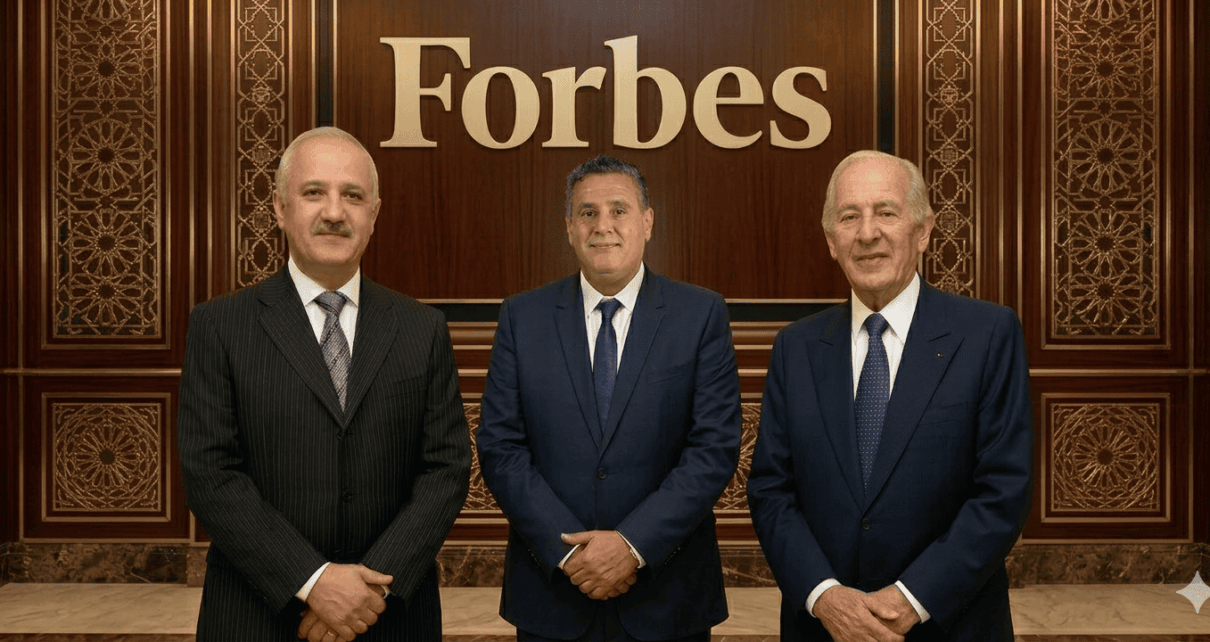
The Forbes 2026 Billionaires List also confirmed Morocco’s three resident billionaires, with mixed fortunes across the trio. Othman Benjelloun, 93, retains the title of Morocco’s wealthiest individual with an estimated net worth of 1.7 billion dollars — a modest increase from the prior year — placing him 2,386th globally and 18th on the African continent. His Bank of Africa group operates across more than 20 African countries with total assets exceeding 12 billion dollars.
Prime Minister Aziz Akhannouch follows in second place with 1.6 billion dollars, built on the sprawling Akwa Group conglomerate active in fuel distribution, gas, and renewables. The gap between the two men has narrowed to just 100 million dollars. Real estate developer Anas Sefrioui of the Addoha Group returns to third place after a brief absence, though his fortune has declined by around 300 million dollars to stand at 1.3 billion dollars, reflecting continued volatility in the property sector.
Morocco’s presence in the Forbes rankings is broadly seen as a reflection of mature, diversified corporate champions rather than spectacular growth stories. Analysts note that the absence of new entrants from technology or innovation sectors represents a structural challenge if the Kingdom is to strengthen its position in a regional landscape increasingly shaped by Gulf sovereign wealth and digital transformation.