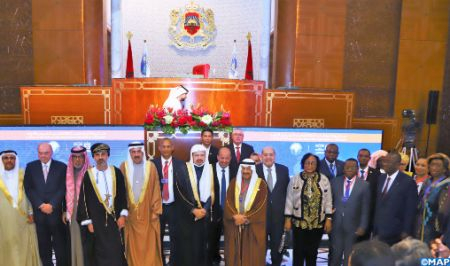
The first African Summit on Health Systems and Health Sovereignty concluded on Saturday with the adoption of the “Dakhla Declaration” that charts the continent’s transition from dependency to sovereignty.
This Declaration reaffirms the right to health for all, equity, intra-African solidarity, and the continent’s leadership in defining its own health solutions.
Through this Declaration, health experts and professionals have highlighted foresightedness in the face of the continent’s vulnerabilities. Recent crises have revealed the fragmentation of health systems, inequalities in access, and above all, a heavy dependence on imports of medicines, vaccines, and technologies, a dependence that has become a real challenge to continental security.
To address these challenges, participants proposed an integrated program based on five pillars. The first focuses on public health and epidemiology, making prevention the cornerstone of public policy.
The second area refers to improving infrastructure and equitable access to care through local services and secure supply chains, while the third emphasizes the need for massive investment in training and skills retention.
The fourth pillar proposes increased funding accompanied by transparent governance, while the fifth emphasizes support for African R&D through the development of local production hubs, including the strategic integration of artificial intelligence.
The Dakhla Declaration sets out an ambitious roadmap for 2030. The year 2026 will be devoted to consolidating the foundations, focusing on prevention and training. In 2027, the priority will switch to access to medicines and vaccines and the integration of artificial intelligence into health systems. The year 2028 will be dedicated to evaluating public policies and developing public-private partnerships, while 2029 will focus on resilience and strategic preparedness. The goal, in 2030, is to achieve African health sovereignty for a more autonomous, stronger, and more united Africa.
Through this Declaration, participants reaffirm their commitment to supporting this trajectory by promoting governance, increasing dedicated budgets, and providing the African Academy of Health Sciences (AAHS) with the necessary resources to coordinate the continent’s networks of excellence.
They also call on all stakeholders, including governments, universities, the private sector, and partners, to join this collective effort, with the ambition of making this decade one of African health renaissance, a confident, competent, and creative Africa, in control of its health and its future.
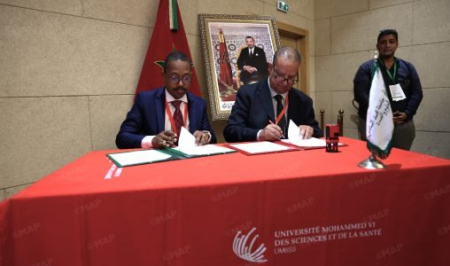
On the sidelines of the summit, Mohammed VI University of Science and Health signed two partnership agreements with Gabon’s University of Science and Health, and Burkina Faso’s Joseph Ki-Zerbo University.