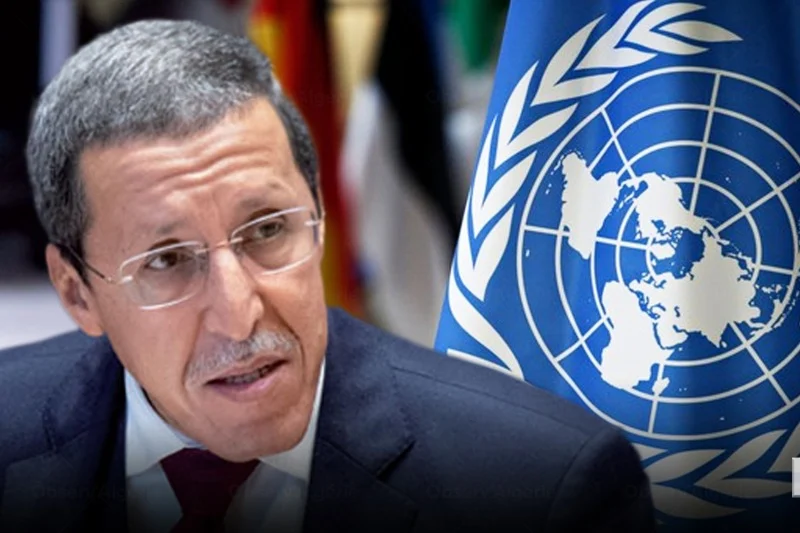
In a measured yet firm response, Morocco’s Permanent Representative to the UN, Omar Hilale, debunked the narrative of the Algerian Foreign Minister Ahmed Attaf regarding the Sahara issue, during the general debate of the 80th session of the UN General Assembly.
Hilale began by recalling that the inclusion of the Sahara issue on the UN agenda was initiated by Morocco itself, 62 years ago. “It was Morocco that registered the Sahara as a decolonization issue at the General Assembly, following its independence in 1956.”
He criticized the Algerian minister’s omission of the UN General Assembly’s Resolution 3458B, which acknowledged the Madrid Accords that ended Spanish colonial rule in the region. “This resolution was adopted in this very hall fifty years ago,” Hilale noted.
The Security Council addresses the Sahara issue not as a decolonization matter, but as a question of peace and security, he said.
He highlighted that since 2007, the Council has consistently endorsed Morocco’s Autonomy Initiative as a “serious and credible” solution, reaffirmed annually through its resolutions.
“The history of the Sahara does not begin or end with MINURSO,” Hilale said, referring to the UN mission established in 1991. He stressed that the Council’s focus has shifted toward a political resolution, with the Autonomy Initiative gaining increasing traction.
Responding to claims of “imposed realities,” Hilale pointed to the socio-economic transformation of Morocco’s southern provinces. “Today’s realities include billions in investments, peace, and stability, Africa’s longest bridge, a transnational highway, universities, teaching hospitals, and the continent’s largest deep-water port on the Atlantic,” he said.
He also cited the active political and civic participation of the local population and the opening of 30 consulates in the region as tangible signs of international recognition of Moroccan sovereignty.
“Even the United States has instructed its agencies and companies to invest in the Sahara,” Hilale added.
Hilale questioned Algeria’s claim of neutrality, noting its continued involvement in setting conditions for resolving the dispute. “If Algeria is not a party, on what basis does it define the parameters of a solution?” he asked, calling for a more constructive Algerian role in the UN-led political process.
He concluded by referencing King Mohammed VI’s Throne Day speech of July 29, 2025, which emphasized Morocco’s commitment to a consensual resolution: “These favorable positions inspire honor and pride. They encourage us to seek a solution that preserves dignity for all parties, with no winners or losers.”
With over 120 countries- including three permanent members of the Security Council and a majority of EU states- supporting Morocco’s Autonomy Initiative, Hilale reaffirmed its status as the only viable path to resolving the long-standing regional dispute.