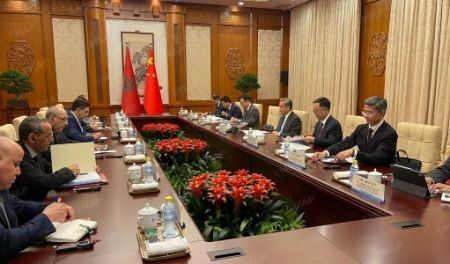
As Morocco continues to diversify its global partnerships, foreign Minister Nasser Bourita’s recent visit to China last week marks a significant step in Rabat’s quest to consolidate international support for its autonomy plan in the Sahara.
The visit, highlighted by the signing of a memorandum of understanding and the establishment of a permanent strategic dialogue mechanism, reflects Morocco’s broader diplomatic posture: a deliberate pivot toward multipolarity.
From Washington to Brussels in addition to Moscow and Beijing, Rabat is leveraging diversified partnerships as a source of geopolitical strength.
After receiving the UN’s personal envoy Staffan de Mistura, Russian diplomacy has formally described the Sahara conflict as a relic of colonialism and backed recent UN security resolutions, which all describe Morocco’s autonomy plan as a serious proposal and urge a political solution based on compromise.
With China, the joint statement following Bourita’s visit stresses the principle of non-interference in domestic issues of sovereign states as Morocco backs the one-China principle.
The growth of Sino-Moroccan dialogue builds on a trajectory initiated during King Mohammed VI’s landmark visit to China in 2016 and reinforced by President Xi Jinping’s visit to Morocco in 2024. These high-level exchanges have laid the foundation for a partnership that now extends beyond trade to encompass political coordination and strategic alignment.
The language used in Bourita’s meetings with his Chinese counterpart- emphasizing solidarity, mutual respect, and trust- signals a shared intent to build an equal and multidimensional relationship.
The joint communiqué notably underscores a willingness to explore new forms of multilateral coordination, suggesting a maturing and structured partnership.
Crucially, the Sahara issue is emerging as a focal point in this evolving relationship. While China has traditionally maintained a cautious stance, recent developments suggest a subtle but meaningful shift.
Indicators include the exclusion of Polisario representatives from major Sino-African forums, nuanced official statements in multilateral settings, and growing international analyses pointing to a recalibration of Beijing’s position in favor of Morocco’s sovereignty over the Sahara.
This shift is driven by converging interests. Morocco offers China a stable investment environment with strategic access to European and West African markets. For Beijing, whose African policy prioritizes economic pragmatism and regional stability, Morocco presents a reliable partner aligned with its long-term objectives.
Rabat’s message is clear: any deepening of bilateral ties must acknowledge the reality of Morocco’s territorial integrity within an autonomy framework.