Europe’s main phosphorus conference was held in Morocco, for the first time in Africa, Nov
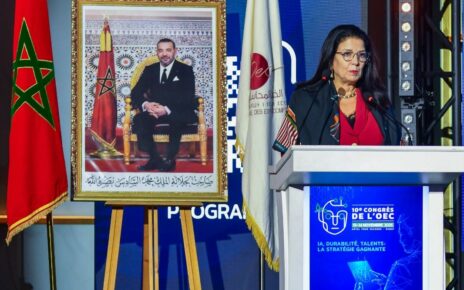
24-26. More than 300 scientists, officials, farmers’ groups and business leaders gathered at Mohammed VI Polytechnic University (UM6P) in Benguerir, near Marrakech, for the sixth edition of the event, co-organized for the first time with Morocco’s state-owned phosphate company OCP.
The organizer, the European Sustainable Phosphorus Platform (ESPP), is a non-profit group with more than 50 members. Phosphorus is one of three main fertilizer nutrients, with nitrogen and potassium, and has no substitute, yet much of it is wasted when it washes into rivers or ends up in sewage.
Topics discussed at the event included soil testing so farmers apply only what crops need, locally tailored fertilizers and recovering phosphorus from wastewater and manure. OCP’s chief global affairs officer, Meriem El Asraoui, said better soil knowledge helps African farmers raise productivity while conserving resources. More than 50 young researchers presented their work during the conference that was attended by representatives of the International Atomic Energy Agency, and universities in Japan, Germany, the Netherlands, Denmark and Brazil.
Morocco holds about 50 billion tons of phosphate rock, roughly 68% of known reserves, according to the US Geological Survey, against 3.4 billion for China. OCP, founded in 1920, employs more than 17,000 people and serves over 350 customers on five continents. Its revenue rose 17% to MAD 113.9 billion in 2025, but sales fell 7% to MAD 48.4 billion in the first half of 2026 on higher sulphur costs and weaker demand.
African farmers use about 18 kg of fertilizer per hectare, against a global average of about 135 kg, according to figures presented at a 2024 summit in Nairobi, where leaders pledged to triple fertilizer production and use over ten years. Europe has almost no phosphate of its own, and the EU lists phosphate rock as a critical raw material.