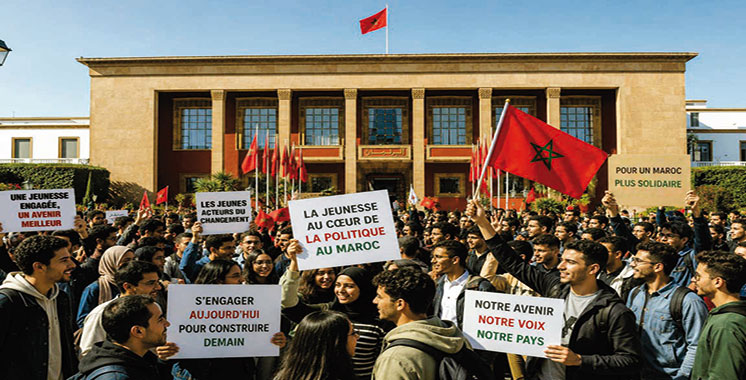
Forms of political engagement among Morocco’s youth are shifting toward horizontal, decentralized structures shaped heavily by digital tools, according to the recent reports of Morocco’s Economic, Social, and Environmental Council (CESE). Recent youth mobilizations within student collective and spontaneous movements have relied increasingly on digital platforms such as Discord for organizing, coordinating and voicing demands, a fast, direct and collaborative communication over traditional channels.
Researchers interpret these expressions as signaling both a shift in how young people participate politically and lower trust in traditional political institutions. Youth representatives from political parties heard by the CESE attributed this partly to political elites’ difficulty addressing recurring economic and social crises affecting young people, perceptions around ethics and probity following cases involving political figures, critical or dismissive media coverage of politics, and limited renewal of political elites alongside weak youth representation within party leadership.
In response, Morocco has pursued structural reforms to open up the political sphere and encourage youth involvement in representative institutions. A reform of the framework governing legislative elections launched in October 2025 aims to remove obstacles to electoral engagement for those under 35, including public funding covering up to 75 percent of campaign expenses, even for candidates without a party’s official backing.
The reform also introduces provisions to encourage youth involvement in founding political parties and to push parties toward giving them a greater role in the electoral process, a dynamic the CESE suggests could gradually renew Morocco’s political actors and expand avenues for civic engagement, while pushing parties to strengthen youth representation in decision-making bodies and adapt communication to younger generations’ digital habits.
The CESE acknowledges that shifting forms of youth expression remain only partially understood, sometimes generating perceptions of stigmatization rooted less in deliberate intent than in a shortage of adequate analytical frameworks. The council attributes this gap to limited intergenerational communication and still-scarce recent empirical and sociological research capable of mapping these evolving dynamics with precision.