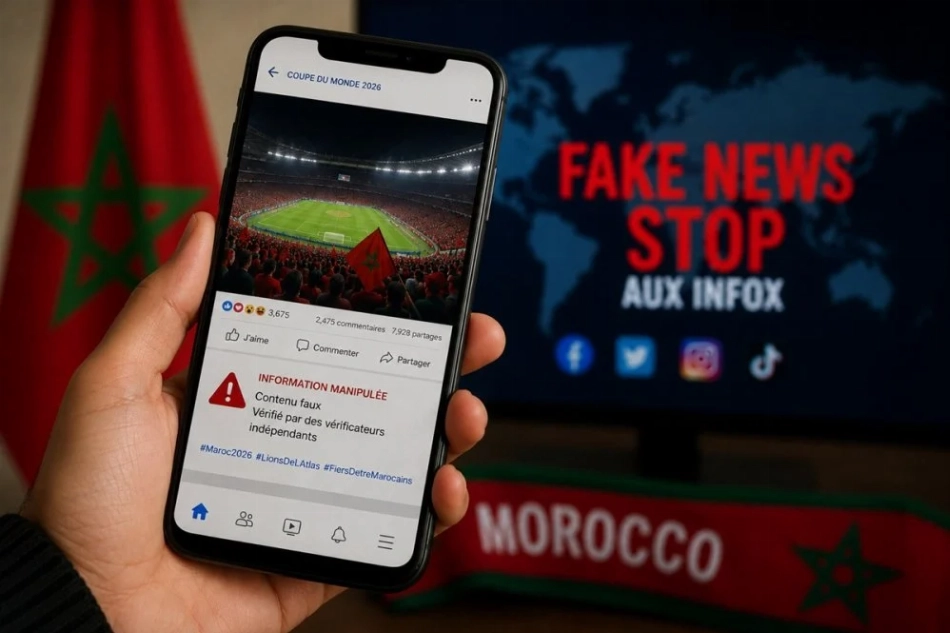
Morocco’s World Cup 2026 campaign played out not only on the pitch but across social media, where a parallel digital battle unfolded involving artificially generated content, disinformation campaigns and identity-driven polarization. That is the central finding of a report from the Moroccan Observatory for Media and Digital Vigilance, based on qualitative analysis of more than 500 publications and interactions across major platforms between 1 June and 13 July 2026.
The report finds that the tournament substantially reinforced Morocco’s international visibility, with the Atlas Lions’ performances generating strong patriotic mobilization and messages of support, particularly across Africa and the Arab world — confirming football’s power as a soft-power and reputation lever. That visibility, however, came with heightened exposure to hostile campaigns, with major sporting competitions increasingly functioning as arenas for digital reputation battles and information sovereignty contests.
A central finding concerns the growing role of artificial intelligence in spreading misleading content. AI-generated images, manipulated videos, fake edits and decontextualized posts circulated widely during the competition, blurring the line between authentic and fabricated content and accelerating the spread of rumors sometimes designed to damage the image of Morocco and its national team. The Observatory also cautions that platform algorithms tend to favor emotionally charged content, giving polemical or provocative posts outsized visibility often well before their veracity can be verified.
The report documents how several discussions shifted from football to identity and political rivalries, noting particularly polarized exchanges between Moroccan, Algerian and Egyptian accounts, with social media becoming an extension of pre-existing tensions around identity, regional influence and national reputation. The authors caution, however, that the most visible content does not necessarily reflect the views of entire populations — a handful of highly active accounts or coordinated campaigns can create an impression of consensus that represents only a limited fraction of actual users.
The Observatory issued twelve recommendations to strengthen Morocco’s resilience against disinformation campaigns, including the creation of a permanent national media and digital monitoring platform, an early-warning system, reinforced digital diplomacy, tools for verifying AI-generated content, and support for professional, multilingual, quality content production. It also emphasizes the need to develop media literacy and digital culture among citizens to encourage fact-checking before sharing information.