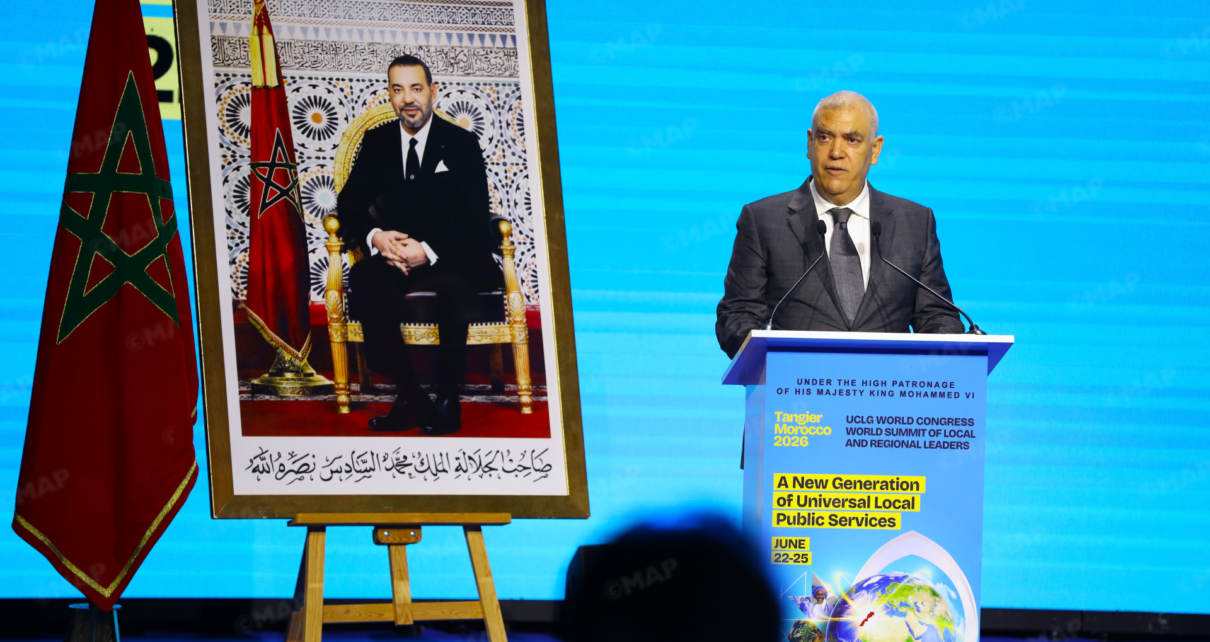
Advanced regionalization is a strategic choice for modernizing the State, consolidating local democracy, unleashing energies, and consecrating each region’s development. Yet, the success of local governance is contingent upon the ability of elected institutions to play their part in full and also upon the competence of elected officials, King Mohammed VI said in an address delivered Tuesday before the 8th World Congress of United Cities and Local Governments (UCLG) held in Tangiers.
“Advanced regionalization, whose foundations I have laid down in Morocco, is a strategic choice for modernizing the State, consolidating local democracy, releasing energies, consecrating the principle of equity among regions, and making sure the development process is tailored to specific characteristics, capabilities, and needs of each region and its inhabitants,” the King emphasized in the address that was read out by Minister of the Interior Abdelouafi Laftit during the Congress opening session.
The Monarch affirmed that this vision has made it possible to enhance the region’s standing as a platform for strategic planning, mobilizing investment, stimulating local economic activity, and pursuing greater cross-sectoral coordination between sectoral and territorial programs.
It has also strengthened the role of prefectures, provinces, and communes as part of an institutional approach based on free enterprise, solidarity, cooperation, and accountability, the Monarch added.
The King stated further that the goal of this initiative is “to establish a creative territorial system that does not stop at managing daily needs, but rather one that is capable of anticipating change, properly channeling investment, keeping pace with the digital and environmental transition, improving the quality of public services, and integrating youth, women, and vulnerable groups into the development dynamic”
The Monarch also recalled that, since his accession to the Throne, he has made territorial reform a strategic pillar of Morocco’s social and development process, because, he said, “I firmly believe that a modern state is not gauged solely by the strength of its central institutions, but also by its ability to empower its local authorities to take the initiative, to participate, to bring public decision-making closer to the citizen, and to ensure that territorial development is the product of integration and concerted efforts between the state, local authorities, and other stakeholders.”
In the same vein, the King observed that Morocco’s experience with decentralization and advanced regionalization derives its strength from being a part of a more comprehensive vision of integrated territorial development.
“I perceive territories as spaces for unleashing energies, mobilizing resources, building partnerships, and making sure local initiatives are in sync with national programs,” the King stated, noting that “with that approach in mind, I have launched a new generation of integrated territorial development programs that reflect a firm desire to revisit work methods in the public sphere.”
This work begins with an accurate diagnosis of the needs of the population, listening to local actors, and setting priorities based on their direct impact on citizens, especially in the areas of employment, education, health, water, and regional development, the Monarch pointed out, adding that the goal is to improve conditions for a dignified life. These programs are important not just because of the size of the projects involved, but also because of the underpinning methodology, which is grounded in consultation, contracting, monitoring, evaluation, efficient use of resources, and a focus on making sure results match the goals sought, he explained.
Territorial development thus becomes a common aspiration – one in which the State, local governments, the private sector and civil society shoulder a common responsibility, which is to formulate projects, implement them, and assess their impact.
The success of local governance is contingent upon the ability of elected institutions to play their part in full. It also hinges on the competence of elected officials, on strengthening consultation mechanisms, and on building partnerships across all levels of public administration, the Monarch stated.