Despite years of economic expansion, Morocco’s informal sector has proven stubbornly resistant to formalization — a phenomenon that two economists from the Policy Center for the New South attribute not to a lack of growth, but to a structural mismatch between the costs and benefits of formal status. In a recent discussion held at the restitution of analyses from the Oxford Handbook of the Moroccan Economy, Hamza Saoudi and Adnane Lahzaoui offered a diagnosis of informality that refuses easy remedies.
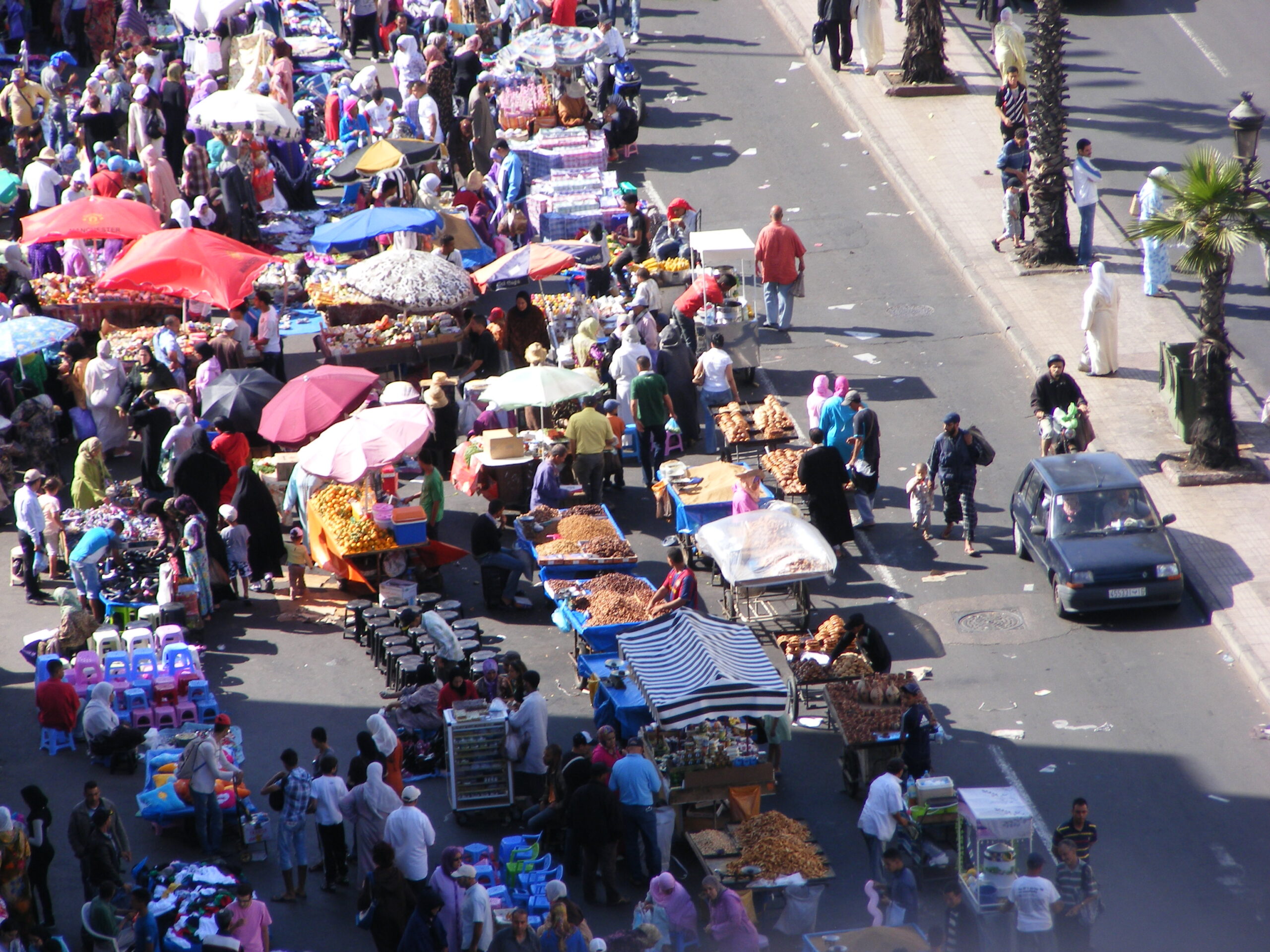
The scale of the challenge is significant. Depending on the methodology applied, informal activity represents either around 30 percent of GDP — under the broadest estimates — or approximately 11.5 percent under the narrower HCP framework, which focuses on non-agricultural informal production units. The sector encompasses roughly two million units, concentrated at around 77 percent in urban areas, with a strong presence in the Casablanca region, and operating primarily in retail trade and services. Its productivity, critically, is estimated at around half the national average, and investment rates are correspondingly low: only 14 percent of informal enterprises invest in physical capital, and fewer than 9 percent invest in human capital.
Saoudi underlines the social function of informality, which should not be underestimated. Morocco’s labor market must absorb around 400,000 new entrants annually. Those who cannot find formal employment do not disappear — they gravitate towards informal activity, which acts as a buffer against unemployment and economic shocks. The Covid crisis demonstrated this absorber role clearly. However, this protective function comes at a cost: weakened social protection systems, reduced fiscal revenues, and suppressed productivity across the economy.
The limits of a growth-led approach are illustrated by long-run trends. Despite near-doubling of GDP per capita between 2000 and 2021, informal employment declined by only around ten percentage points. The more rapid recent fall — to approximately 29 percent of total employment — is largely attributable to the post-2021 social protection reform, which extended coverage to some 3.5 million previously unregistered workers. The sustainability of this shift depends on whether newly covered workers continue to contribute once they weigh the tangible benefits against the costs.
The core policy recommendation that emerges from the analysis is that formalization cannot be achieved through administrative registration drives or enforcement alone. It requires making formal status concretely more advantageous than informal status — through improvements in social protection quality, targeted labor code flexibility, a reduction of fiscal step effects that penalize growth, and expanded access to public procurement and digital payment channels. As Saoudi argues, workers and enterprises are not evading the formal sector out of civic indifference; they are responding rationally to the incentive structure they face.