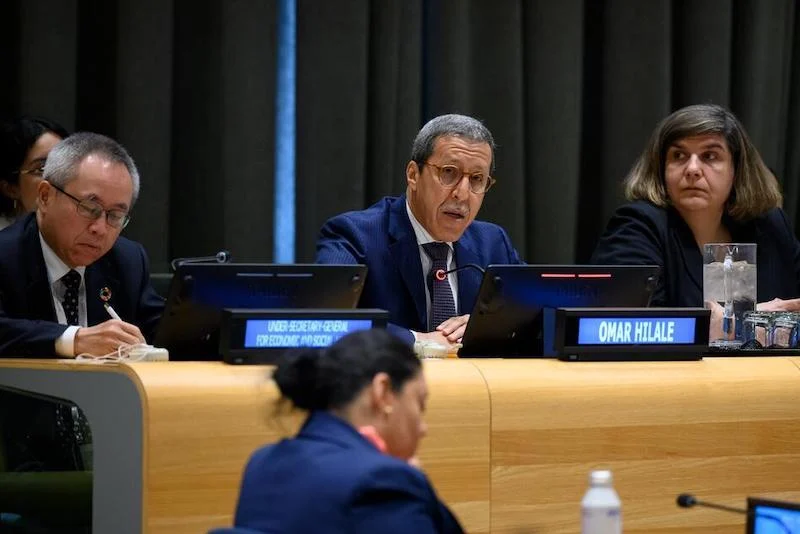
Morocco’s Permanent Representative to the United Nations, Omar Hilale, co-chaired, Friday in New York, a high-level meeting of the UN Group of Friends on Artificial Intelligence for Sustainable Development, which focused on preparations for the first Global Dialogue on AI governance, slated for July 6–7 in Geneva, Switzerland.
During the meeting, the Global Dialogue’s co-chairs- Ambassadors Egriselda López of El Salvador and Rein Tammsaar of Estonia – along with New York-based directors from UNESCO and the International Telecommunication Union (ITU) updated delegations on the preparations and the expected agenda for the two-day event in Geneva.
In his opening remarks, Hilale described the Geneva gathering as “a test of the multilateral system’s capacity to govern a technology of such a scale.”
“If we fail, the rules governing artificial intelligence will continue to be written within exclusive clubs, and the fragmentation we see today will only deepen,” he warned delegates from the Group of 60+ member states.
Offering a candid assessment, the ambassador said that AI “has moved out of the laboratories. According to UNCTAD, its market is projected to reach $4.8 trillion by 2033, while just a hundred companies account for 40% of global research spending in the field.”
“Even more telling: only seven developed countries participate in all major international AI governance initiatives, while 118 do not take part in any of them,” he noted, adding that “the majority of humanity is simply absent from the rooms where the rules are being written.”
It is against this backdrop that the Global Dialogue on AI Governance seeks to rectify this anomaly by bringing together – for the first time – all 193 member states on an equal footing, alongside scientists, the private sector, and civil society.
This marginalization is not the only imbalance highlighted by ambassador Hilale. The challenges posed by AI now extend far beyond the technical realm; they are geopolitical, ethical, economic, and social in nature.
“The question is no longer what machines can do. The question is who decides, who benefits, and who is left behind,” he insisted, calling for an AI framework developed in collaboration with all countries—including those in Africa, “where 60% of the population is under the age of 25, making it the youngest population in the world and the one with the most to gain and the most to lose.”
Morocco, together with the United States, spearheaded the first UN resolution on artificial intelligence, which was adopted by the General Assembly in March 2024 and co-sponsored by more than 120 member states. Subsequently, Hilale and his U.S. counterpart established the UN Group of Friends on Artificial Intelligence, which they currently co-chair.