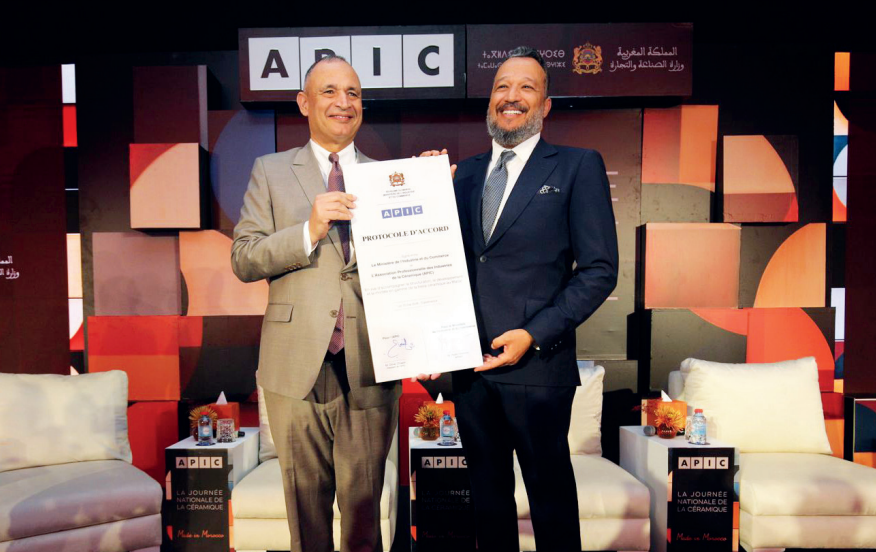
The Professional Association of Ceramic Industries (APIC) and the Ministry of Industry and Trade signed a strategic framework agreement at the inaugural National Ceramics Day in Casablanca earlier this month, formalizing a 2026-2030 Ceramic Accord designed to accompany the structural transformation of a sector that Minister Ryad Mezzour described as historically embedded in the country’s industrial identity. The accord’s five strategic axes — industrial competitiveness, energy efficiency, market structuring, quality upgrading, and innovation — reflect both the sector’s current strengths and the gap between its current positioning and its potential.
Omar Chaabi, President of APIC, argued that Morocco’s ceramic industry now possesses the industrial fundamentals needed to move to the next level, and that the key challenge is to build a joint public-private trajectory toward a more competitive, innovative, and value-generating sector. Mezzour was characteristically direct: “If I can export plastic connectors to China, I think a ceramic of the quality you produce has a legitimate place in the world’s largest market.” His message was clear — the sector’s aspiration should not be limited to import substitution or regional distribution but to global export positioning.
The framing of the Made in Morocco label’s relevance to ceramics is explicit in the accord. Seven of the 80 companies that received the inaugural Made in Morocco certification last week are ceramic manufacturers: Super Cérame Berrechid, Casablanca, Kénitra, and Tétouan; Ghorghiz Cérame; Grand Cérame; and Multicérame. Their certification signals that the sector’s leading producers have voluntarily submitted to international best-practice evaluation frameworks and are ready to compete on quality, traceability, and compliance dimensions.
The Moroccan Agency for Investment and Export Development (AMDIE) reported that ceramic sector exports have already reached $110 million, with the agency’s Export pour l’économie program — which has attracted close to 400 beneficiaries across industries — actively supporting ceramic operators in accessing international trade fairs, distribution networks, and major buying centers. Director General Ali Seddiki highlighted participation in international Launch Shows as a key tool for connecting Moroccan producers directly with global purchasing decision-makers.
The strategic logic of the Ceramic Accord connects multiple policy strands that have been advancing in parallel: the Made in Morocco label for product credibility, the industrial sovereignty target of 70 percent local content, the CGEM’s ambition to build export-capable industrial ecosystems, and the energy efficiency imperative driven by Morocco’s CBAM exposure as a European exporter. A sector that currently consumes significant energy in kiln-based production has particular incentive to invest in efficiency and renewable energy integration — and the new accord explicitly identifies energy efficiency as one of its five strategic pillars.