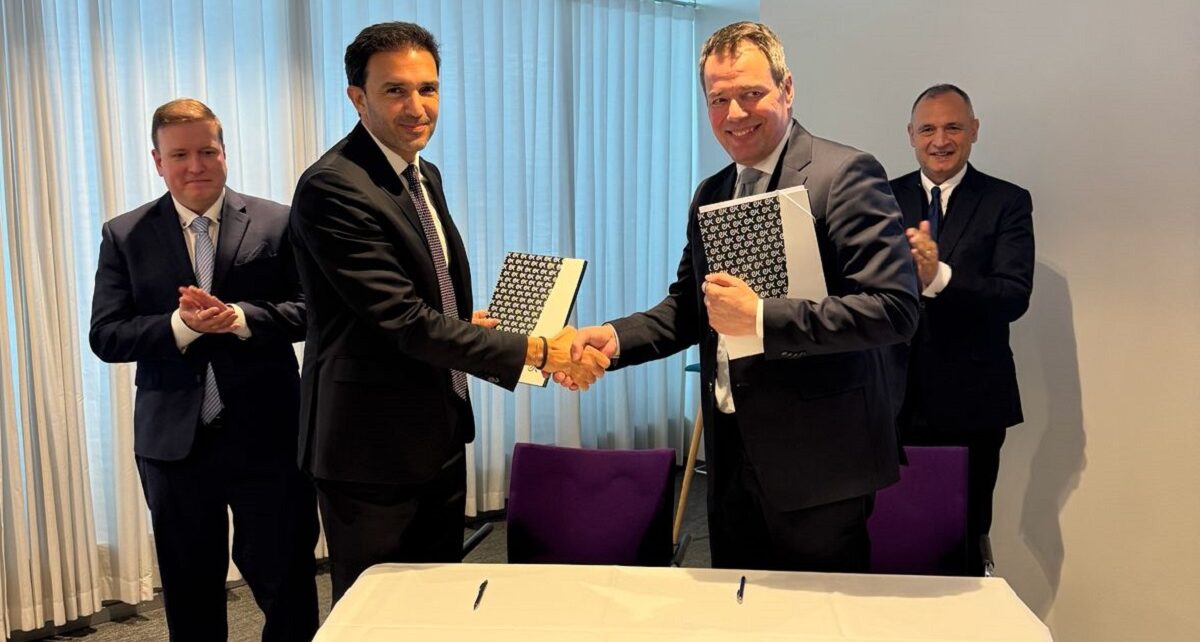
The General Confederation of Moroccan Enterprises (CGEM) and the Confederation of Finnish Industries (EK) signed, in Helsinki this week, a partnership agreement, establishing the Morocco-Finland Business Council as a permanent bilateral platform for private-sector dialogue and co-investment development. The signing ceremony took place at the Finland-Morocco Economic Forum co-organized by the two federations, in the presence of Morocco’s Industry and Trade Minister Ryad Mezzour and Finland’s Minister of Foreign Trade and Development Ville Tavio.
The agreement was signed by CGEM President Mehdi Tazi and EK Executive Vice President Petri Vuorio. The Helsinki visit represents Tazi’s first major foreign economic diplomacy outing since taking the CGEM presidency, just two weeks ago with 91.5 percent of the vote, and the choice of Finland — a Nordic technology and engineering powerhouse with significant expertise in maritime industries, mining, decarbonation solutions, automation, and water management — reflects a deliberate sectoral alignment with Morocco’s current industrial transformation priorities.
The Business Council is designed to function as a structured architecture for accelerating synergies between Moroccan and Finnish enterprises, with a particular focus on industries of the future, technology transfer, and joint project development. The forum itself explored five thematic dimensions: advanced maritime technologies, mining industries, industrial decarbonation solutions, automation, and water management — all areas where Finnish companies are internationally competitive and where Morocco is actively seeking partnerships to support its industrial upgrading.
Tazi seized the occasion to present the trajectory of Morocco’s industrial upgrading, emphasizing the country’s strong performance in automotive, aeronautics, renewable energy, and green hydrogen — sectors attracting sustained foreign investment and progressively deepening their local content. He also highlighted Morocco’s role as a strategic hub toward African markets, pointing to the infrastructure of Tanger Med, Nador West Med, and the future Dakhla Atlantic Port as the logistical backbone enabling the deployment of industrial value chains at continental scale.
The Helsinki accord is the latest in a sequence of bilateral business council formations that has gathered pace in 2026, as the new CGEM leadership team — whose manifesto explicitly targets expanded international reach and European industrial partnership — begins to operationalize its program. Morocco’s designation as Africa’s leading industrial economy by the AfDB, announced just this week, provides a compelling positioning argument for exactly these kinds of outreach missions to countries where Morocco’s industrial credentials are still being discovered.