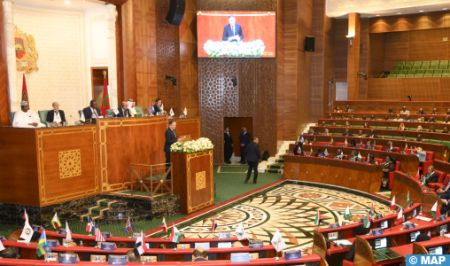
The Foreign Ministers of several countries who took part in the 2nd Ministerial Conference on Peacekeeping in a Francophone Environments hosted by Rabat this week held on the sidelines of the conference talks with their Moroccan peer Nasser Bourita.
These officials have joined their voices to the chorus of countries which have affirmed or reaffirmed their constant support of Morocco’s territorial integrity and sovereignty over its Sahara southern provinces.
In this vein, Guinean Foreign Minister Morissanda Kouyaté reaffirmed his country’s firm, constant, and unwavering position regarding Morocco’s sovereignty over the Sahara.
Kouyaté recalled that Guinea has always stood alongside Morocco and has steadily supported its territorial integrity and sovereignty over all of its territory, including the Sahara region.
He also reaffirmed his country’s support for the Morocco-proposed Autonomy Initiative as the only credible and realistic solution to this regional dispute, specifying that this support is part of the growing international consensus around the initiative, driven by the momentum initiated by King Mohammed VI.
The head of Guinean diplomacy welcomed the historic adoption, on October 31, 2025, by the United Nations Security Council of Resolution 2797, which enshrines, within the framework of Moroccan sovereignty, the autonomy plan proposed by Morocco as the only serious, credible, and lasting basis for achieving a political solution to the artificial dispute over the Sahara.
Minister of Foreign Affairs of the Central African Republic, Sylvie Baïpo-Temon, reiterated her country’s steadfast position in support for Morocco’s territorial integrity and sovereignty over its entire territory, including the Sahara region, and for the autonomy plan.
She also welcomed the historic adoption of UN Security Council Resolution 2797, which enshrines the autonomy plan under Moroccan sovereignty, as the sole basis for a just, lasting and mutually acceptable settlement of the dispute.
Following her meeting with Bourita, Haiti’s Minister of Foreign Affairs Raina Forbin also reiterated her country’s constant position in favor of the territorial integrity and sovereignty of Morocco over all of its territory.
She further reaffirmed Haiti’s support for the Autonomy Plan and welcomed the adoption of Resolution 2797, which endorses, within the framework of Moroccan sovereignty, the Autonomy Plan as the sole serious, credible, and lasting basis for achieving a political solution to this issue.
Raina Forbin also praised the significant progress achieved by Morocco in the socio-economic development of the Southern Provinces through the New Development Model, which promotes stability, security, and regional integration.
Haiti was among the first countries to open, in December 2020, a Consulate General in Dakhla, after it opened an Embassy in Rabat.
Panamanian Deputy Minister of Foreign Affairs, Carlos Arturo Hoyos Boyd, who was on a working visit to Morocco, reaffirmed after his meeting with Bourita Panama’s constant position on the Sahara issue and support for the autonomy initiative under Moroccan sovereignty, as the only serious, credible, and realistic basis for achieving a lasting solution to this regional dispute, within the framework of the process led under the aegis of the United Nations and in full respect of Morocco’s sovereignty and territorial integrity.
In this context, he emphasized that the Embassy of Panama in Morocco fully exercises its consular powers over the entire Moroccan territory, including the Southern Provinces.
France, Côte d’Ivoire, and the Commonwealth of Dominica have also renewed constant support for Morocco’s territorial integrity and sovereignty over its entire territory.