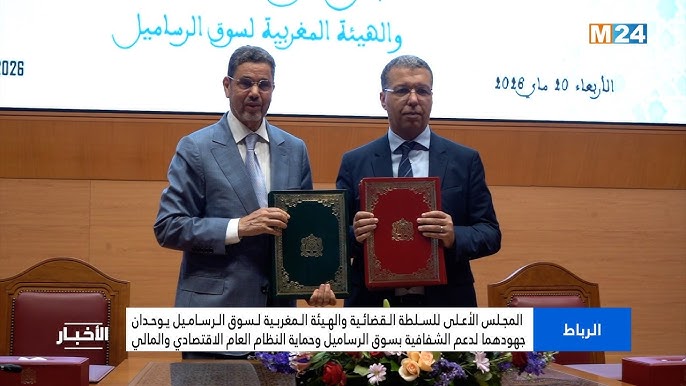
The Higher Council of the Judiciary (CSPJ) and the Moroccan Capital Market Authority (AMMC) formalized a framework partnership agreement in Rabat this week, translating the two institutions’ shared commitment to protecting the country’s economic and financial public order.
The accord was signed by Mohamed Abdennabaoui, First President of the Court of Cassation and Deputy President of the CSPJ, and Tarik Senhaji, President of the AMMC.
The agreement is built around four axes of cooperation: the exchange of expertise and technical documentation; specialized legal training for judges and market surveillance professionals; support for research and capacity building in areas linked to capital markets litigation and judicial procedure; and joint work on the legal and regulatory dimensions of new financial technologies. The two institutions will organize training sessions and scientific workshops on stock market offences, money laundering, terrorist financing, and recent developments in financial crime, as well as seminars on offences related to financial instruments.
Abdennabaoui framed the partnership as a response to a structural challenge: the accelerating pace of economic and financial change, combined with the rise of modern financial technologies and crypto-assets, has made legal and judicial security a prerequisite for economic security. He argued that independent and efficient justice, strong governance institutions, and effective regulation are inseparable from the investment attractiveness and the development ambition that Morocco’s leadership has articulated. He connected the agreement to Royal Orientations on improving the business climate, justice reform, and the fight against corruption.
Senhaji described the partnership as reflecting shared values and a common vision between the two institutions in service of the public interest. Morocco’s capital market, he noted, has seen growing momentum in recent years — higher volumes mobilized to finance the economy, rising market capitalization, and increasing participation by individual investors. This expansion requires responsible and coordinated regulation anchored in transparency and market integrity, he argued, as the foundations of investor trust and the preconditions for a market that functions fairly and efficiently.
The agreement arrives at a moment of intensifying attention to financial market governance in Morocco. The draft crypto-assets regulation framework, currently in public consultation, the recent enforcement notices issued by the Office des Changes against crypto holders, and the sustained expansion of Casablanca’s capital markets collectively make the strengthening of the institutional architecture linking regulators and the judiciary both timely and necessary.