Germany has reaffirmed its steadfast support for the Autonomy plan in the Sahara under Moroccan sovereignty, saying the plan endorsed by UN Security Council Resolution 2797 offers a “serious and credible basis” for reaching a lasting solution to this five-decade long regional dispute.
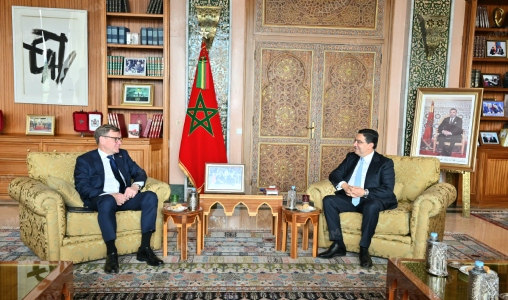
The supportive position of the German Federal government of the Moroccan Sahara comes in the joint Declaration issued Thursday in Rabat following the 2nd session of the Morocco-Germany Multidimensional Strategic Dialogue held under co-chairmanship of the two countries’ Foreign Ministers, Dr. Johann David Wadephul and Nasser Bourita.
Germany has pledged to act in accordance with its position at the diplomatic and economic levels. It has also reiterated backing to the UN Secretary-General and his Personal Envoy in facilitating and conducting negotiations, taking as a basis Morocco’s Autonomy Proposal, with a view to achieving a just, lasting and mutually acceptable resolution of the dispute.
The two countries’ FMs welcomed the positive dynamics in bilateral relations since the 1st session of the Morocco-Germany Multidimensional Strategic Dialogue, convened in Berlin June 28, 2024.
During the second session of the Strategic Dialogue, the two sides took the opportunity to reiterate its objectives, namely, the preservation of the priority interests of the two countries, the strengthening of coherence in the various areas of bilateral cooperation, the exploration of new opportunities for mutually beneficial collaboration and partnership in key sectors, the strengthening of trust & mutual understanding, and the consolidation of cooperation in the political, economic, social, cultural and security fields.
The two officials welcomed the efforts and progress made since the adoption of the 2024 Berlin Joint Declaration. They welcomed with satisfaction the important progress in implementing the joint agenda defined in the Joint Declaration and reaffirmed their common commitment to continue the implementation based on shared values, common interests and mutual respect.
In the joint statement, the German FM lauded the reforms undertaken by Morocco, under the leadership of King Mohammed VI, for advancing the political, economic, and social development of the country for the benefit of all Moroccans.
The two Ministers hailed the German investments and substantial engagement of the German private sector in Morocco, notably in the automotive, aviation, pharmaceutical and digital industry, and highlighted the opportunities in the field of renewable hydrogen and energy transition as well as, among others, in infrastructure and circular economy.
They also reaffirmed their commitment to further developing investment and trade relations and encouraged economic actors to develop existing and explore new opportunities. They emphasized Morocco’s significant investment potential and highlighted Morocco’s participation in the G20 “Compact with Africa” initiative.
The two Foreign Ministers commended the remarkable momentum in trade between Germany and Morocco, marked by record growth and an even trade balance. They welcomed the continued strengthening of the bilateral economic partnership and the rise of the Kingdom’s position among Germany’s trading partners.
Bourita and his German peer stressed the importance of the bilateral Joint Economic Commission, noting that regular Moroccan-German Economic Forums will serve as a key platform bringing together public and private stakeholders from both countries to strengthen industrial partnerships, facilitate trade, promote cross-investment, and support strategic projects, particularly in the areas of industry, integrated value chains, renewable energy and hydrogen and digitalization including AI.
The two sides agreed to work to tap the high potential of complementarities and opportunities that the economic relations between Morocco and Germany offer. German private investments in Morocco support sustainable development, vocational training, and SMEs.
The Moroccan and German foreign ministers reiterated their interest in continuing triangular cooperation, such as the Femmpact project, and South-South cooperation for the benefit of the African continent, building on the experiences gained within the framework of Moroccan-German cooperation.
They reaffirmed their commitment to promoting an ambitious international effort aiming to limit global warming and fostering resilience for a sustainable prosperous future, among others through cooperation in the areas of forest restoration and climate adaptation, as well as regarding renewables, energy efficiency, and production of green hydrogen.