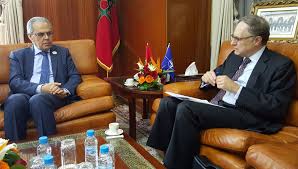
Morocco and the United States on April 29 reaffirmed the depth of their strategic partnership during talks in Rabat that underscored cooperation ranging from the Western Sahara issue and space exploration to trade, investment and defense.
Speaking at a joint news conference with Moroccan Foreign Minister Nasser Bourita, US Deputy Secretary of State Christopher Landau said the two countries were strengthening cooperation built on nearly 250 years of diplomatic ties and shared strategic interests.
Landau welcomed Morocco’s decision to join the Artemis Accords, a US-led international framework governing civil space exploration.
He described Morocco as the 64th signatory to the initiative and hailed the move as a symbol of trust and forward-looking cooperation.
“This is a common human enterprise for the benefit of all humanity, and Morocco is an ideal partner,” Landau said, thanking King Mohammed VI and the Moroccan government for their engagement.
Bourita stressed the historic nature of relations between Rabat and Washington, noting that 2026 marks the 250th anniversary of diplomatic ties dating back to 1777, when Morocco became the first country to recognise U.S. independence.
Both officials pointed to the strength of diplomatic representation as a sign of robust ties. Landau said Morocco would soon host both the newest U.S. diplomatic facility, a consulate scheduled to open in Casablanca, and the oldest, the Tangier legation.
Economic cooperation also featured prominently. Landau said the United States sees significant “win-win” opportunities as Morocco continues to develop one of the most dynamic economies in the region, highlighting U.S. capital and expertise as key assets for future growth.
Bourita said bilateral trade and investment have reached record levels, noting that exchanges have increased sevenfold since the entry into force of the Morocco–US free trade agreement. He recalled that Morocco remains the only African country to have such an agreement with Washington and announced the upcoming ninth meeting of the joint commission overseeing its implementation.
Morocco also formally joined the US-backed “Trade Over Aid” initiative, a move Bourita said reflects King Mohammed VI’s long-standing vision of development driven by trade and investment, particularly in Africa.
On the Sahara, both sides reiterated support for a swift, peaceful resolution based on Morocco’s autonomy plan under its sovereignty. Landau recalled that the United States recognized Morocco’s sovereignty over the territory in 2020 and described the decades-long dispute as “unacceptable.”
“We want a peaceful solution, but also a rapid one,” Landau said, adding that the situation should not be allowed to persist for another generation.
Bourita welcomed Washington’s position, calling it a “major turning point” that underpins US support for a UN-led process centered on the autonomy initiative.
The talks also highlighted close military ties. Bourita pointed to the launch of the 22nd edition of the “African Lion” military exercises – the largest of their kind in Africa – and recent meetings of the joint defense consultative committee in Washington.
“In all areas, Morocco and the United States act as partners and allies, guided by shared values, interests and visions,” Bourita said.