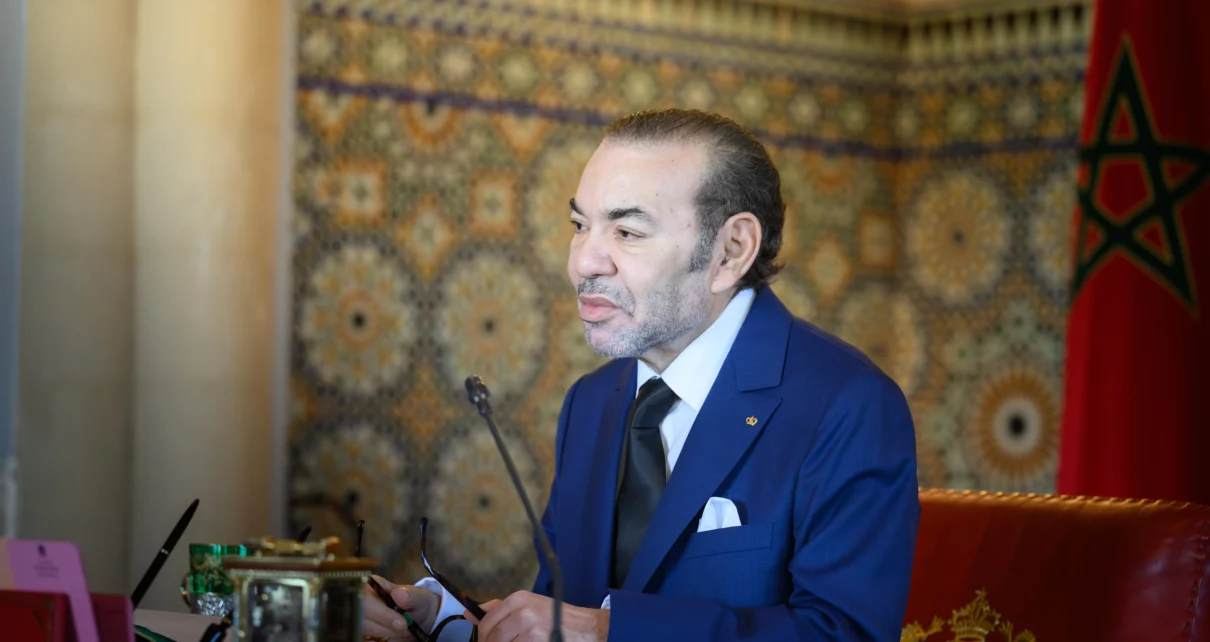
King Mohammed VI chaired in Rabat on Thursday a Council of Ministers that approved an ambitious reform of territorial governance, based on a local and participatory approach, backed by an investment program of nearly 210 billion dirhams over eight years.
The Council of Ministers actually approved a draft organic law amending and supplementing the organic law relating to regions, the Royal Office said in a statement.
This draft is fully in line with the King’s vision aimed at establishing strong and effective advanced regionalization, capable of addressing development challenges and remedying the various aspects of unequal development and spatial disparities.
It also seeks to establish a legal and institutional framework capable of ensuring the optimal and effective implementation of the new generation of integrated territorial development programs, through three main pillars relating to implementation mechanisms, regional competencies, and financial resources.
With regard to implementation mechanisms, regional project execution agencies will be transformed into joint-stock companies (SAs), in order to reconcile the requirements of governance and public oversight with management flexibility and performance efficiency, the aim being to improve the quality of project delivery and accelerate the pace of execution.
Concerning competencies, this reform represents a timely opportunity to clarify and redistribute the region’s own and shared responsibilities, with a focus on the region’s role as a primary driver of economic development.
As for financial resources, this project aims to strengthen the financial capacities of the regions by increasing the ceiling of state transfers to their budgets, enabling them to fully exercise their competencies, enhance their financial autonomy, and ensure their effective and consistent contribution to the financing and implementation of integrated territorial development projects.
Before adopting the draft organic law, the Minister of the Interior made a presentation outlining the governance framework for the new generation of integrated territorial development programs, based on a new approach setting program priorities according to the needs expressed at the local level by citizens, in accordance with the King’s guidelines, as set forth in several Royal Speeches.
The overall design of this major reform project reflects the royal will to make the improvement of citizens’ living conditions and the safeguarding of their dignity the ultimate goal of all public policy, through enhancing the attractiveness of territorial areas, stimulating economic growth and creating jobs.
The minister noted that these programs were developed following extensive consultation and feedback sessions across all prefectures and provinces of the Kingdom, as a territorial assessment was conducted for each prefecture and province based on an analysis of various socioeconomic indicators, and the identification of strengths and weaknesses in terms of the population’s access to employment, education, healthcare, water and territorial development programs.
He emphasized that initial estimates of the total budget for implementing these programs amount to nearly MAD 210 billion over an eight-year period and that a comprehensive plan has been established, setting out the governance, implementation, and evaluation mechanisms for this new generation of programs, as well as the related communication devices.
In terms of governance and steering, a locally driven approach has been adopted, responsible for planning and monitoring, while the national level ensures overall coordination and mobilizes necessary funding.
Thus, a committee will be established at the local level, chaired by the governor of the prefecture or province and composed of elected officials and representatives of decentralized State-affiliated services. Its mission will consist in developing programs and monitoring project execution, as well as consulting the target populations to address their needs, while ensuring that the potential of the regions concerned is fully upheld.
A committee, chaired by the Wali of the region, will be tasked with enshrining integrated territorial development programs for the region’s prefectures and provinces, while ensuring alignment of projects.
At the national level, a national committee chaired by the Head of Government will be established. It will be composed of the relevant ministerial departments and will be responsible for program validation, ensuring their integration and coordination, and establishing monitoring and assessment indicators to measure their impacts.
Regarding oversight and accountability, the implementation of these programs will be subject to an annual audit conducted jointly by the General Inspectorate of Finance and the General Inspectorate of Territorial Administration to assess performance and ensure compliance with the execution procedures.
Meanwhile, a dedicated digital platform will be set up to ensure widespread communication regarding integrated territorial development programs, to enable all citizens and institutional stakeholders to access comprehensive information on program planning, work progress and the achievement of projects, thereby ensuring maximum transparency and regular monitoring of the actions undertaken.
At the onset of the Council’s proceedings, the King asked the minister of Agriculture, Maritime Fisheries, Rural Development, and Water and Forests for an update on the progress of the current agricultural season.
The minister explained that this season has been marked by very heavy rainfall, which has contributed to the revival of various agricultural activities, pointing to promising prospects for the harvest.
The rains fell over all regions of the Kingdom, with an annual average of 520 millimeters—a 54% increase compared to the annual average of the past thirty years—which positively impacted dam reservoir levels, now standing at 12.8 billion m3, with a 75% fill rate. These reserves will help the country meet the irrigation water needs of spring and summer crops, as well as those at the start of the next agricultural season.
Regarding fruit trees, Morocco recorded significant production of olives, citrus fruits, and dates, with a record production of 2 million tons of olives—an increase of 111% compared to the previous year— a production of 1.9 million tons of citrus fruits (25% increase), and a production of 160,000 tons of dates, standing for a 55% increase compared to last season.
In accordance with the royal instructions regarding the replenishment of the national livestock, the minister emphasized that rain has contributed to abundant pastures and an improvement of livestock conditions.
The Ministers’ council approved, besides the reforms, a draft decree relating to military affairs, as well as a set of international agreements and appointments to senior positions.