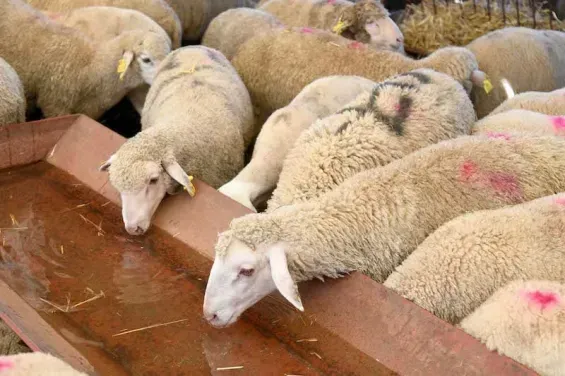
Morocco’s livestock reconstitution program has achieved substantial progress with the establishment of a comprehensive database documenting 32.8 million animal head and approximately 1.2 million herders, Agriculture Minister Ahmed El Bouari announced Tuesday in Rabat.
Speaking before the Chamber of Counselors regarding measures to preserve and strengthen national livestock, El Bouari explained that the database has enabled identification of direct aid beneficiaries and facilitated the livestock tagging operation. As of Monday, authorities had identified 25 million head, representing 92 percent of registered herders.
The direct aid program applies to registered and tagged livestock according to specific criteria. For sheep, compensation stands at 150 dirhams per head for the first ten animals, decreasing to 125 dirhams for heads 11 through 50, 100 dirhams for heads 51 through 100, and 75 dirhams beyond 100 head.
Goat compensation follows a similar structure, starting at 100 dirhams per head for the first ten animals and declining progressively to 50 dirhams for animals exceeding 200 head. Cattle and camel herders receive 400 dirhams per head for their first five animals, with amounts decreasing based on herd size.
The program includes breeding female retention bonuses for sheep and goats registered between June 26 and August 11, 2025. Female sheep qualify for 400 dirhams while female goats receive 300 dirhams, paid in two installments with verification required before the second payment in April 2026.
In close coordination with the Interior and Finance ministries, authorities have established robust financial management mechanisms. To date, officials have processed applications from 1.102 million herders, disbursing 4.465 billion dirhams to nearly 977,000 beneficiaries within one month.
El Bouari emphasized that compensation payments will continue until all registered herders receive support, helping reduce production costs and strengthen red meat supply in domestic markets. The ministry employs a participatory approach to prevent eligible herders from being excluded while ensuring supply stability and price control.
The three-year program, allocated approximately 2 billion dirhams, targets rural youth and women. Currently, 68 projects have been approved across 46 provinces and 199 communes, reaching 28,000 beneficiaries and mobilizing over 544 million dirhams. Officials project the total will reach 200 solidarity agriculture projects focused on livestock by program completion.