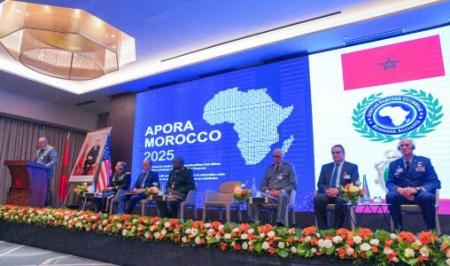
the Royal Armed Forces (FAR) is organizing, in partnership with the United States Africa Command (AFRICOM), the African Partnership Outbreak Response Alliance workshop (APORA Morocco 2025), held under the theme “Strengthening Health Security: Operationalizing Civil-Military Collaboration in Outbreak Preparedness and Response.”
The workshop, falling in line with the vision of King Mohammed VI, Supreme Commander and Chief of the General Staff of the FAR, aimed at strengthening health cooperation on the African continent, enshrines a strong and lasting partnership and contributes to the development of an effective continental network to anticipate and manage health threats.
Over four days, from December 8 through 12, African and American experts are discussing major topics such as epidemiological surveillance, crisis management, emergency communication, the impacts of climate change, and national capacity building.
The objectives of this workshop include strengthening capacity development and promoting training for defense staff, identifying best practices and sharing them among members, and formulating practical and operational recommendations to improve collective response to epidemics and effectively support civil authorities.
Speaking at the opening session of the workshop, Brigadier General Omar Agadr, Deputy Inspector of Morocco’s Military Health Service, noted that public health is no longer an isolated field, specifying that it has become a strategic issue, a pillar of stability, and a lever for development.
In this regard, he called for efforts to be focused on the common goal of strengthening the continent’s health resilience, while acting in a proactive, coordinated, and sustainable manner, noting that the complementarity of the civilian and military sectors form a solid basis for anticipating, detecting, and responding effectively to outbreaks.
For his part, Colonel Julius Nvobegahay, APORA’s President, emphasized the need to bolster capacities and share best practices among countries of the Alliance, adding that “by joining forces, sharing data and experiences, and coordinating actions on the ground, we are building the health security of Africa’s future.”
For his part, Director of Epidemiology and Disease Control at the Ministry of Health and Social Protection Mohamed El Youbi, highlighted the different aspects of civil-military cooperation, giving examples such as the presence of military experts in various national technical and scientific committees and the contribution of military laboratories in diagnosing pathogens of emerging and re-emerging diseases.
In a statement to the press, Brigadier General Khalid Ennibi, head of the Center for Virology, Infectious and Tropical Diseases at the Mohammed V Military Teaching Hospital, said that in the face of cross-borders health threats, it is mandatory for Africa to have a health system capable of early detection of risks, understanding their mechanisms, and responding effectively.
However, this strategy faces several challenges, including the effects of global warming, limited available resources, and recurring outbreaks, possibly exceeding national surveillance capacities, he noted, adding that this meeting is a unique opportunity to examine these challenges and formulate concrete recommendations.
Created in 2014 by AFRICOM in Ghana in response to the devastating Ebola crisis in Africa, APORA currently brings together 38 African countries in a decentralized governance model. Its vision is to attain an epidemic-free continent through close collaboration between armed forces and civilian authorities to prevent, detect, and respond to infectious diseases.
It is supported by an Executive Board, military focal points, and working groups composed of experts from several disciplines, and operates through four standing committees (strategic, policy, response manual, scientific) and ad hoc committees, as needed.
With the support of experienced military and civilian advisers, APORA aims to strengthen states’ epidemic response capacities by integrating public health actions and security demands, thus positioning itself as a major player in health security in Africa.