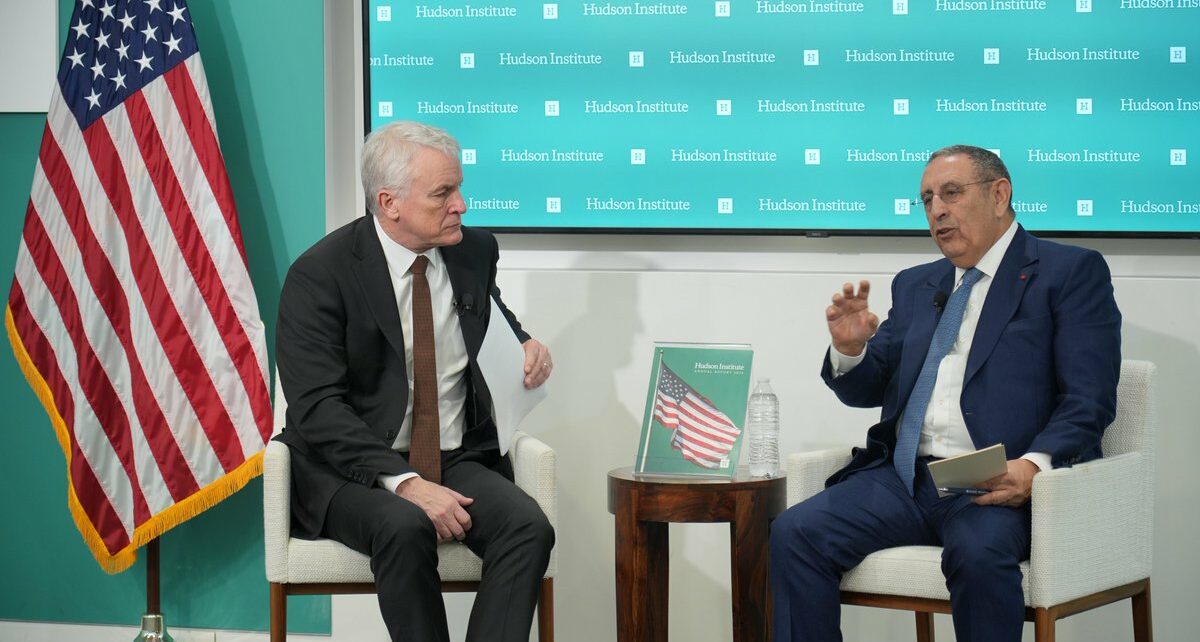
The adoption of UN Security Council Resolution 2797 marks not only a diplomatic milestone but also enshrines the “centrality, legitimacy and relevance” of Morocco’s autonomy plan as the ultimate solution to the regional dispute over the Sahara, Morocco’s Ambassador to Washington, Youssef Amrani, told the US Think Tank Hudson Institute.
This “historic resolution” provides “unambiguous clarity” and sets an irreversible course for international consensus in favor of autonomy under Moroccan sovereignty, Amrani told the Think Tank in a discussion Michael Doran, Senior Fellow and Director of the Center for Peace and Security in the Middle East.
The Resolution 2797, adopted with no objections, “constitutes a rare political signal in today’s diplomatic environment, reflecting a profound shift within the international community toward structural and explicit support for the autonomy plan.”
“More than 120 countries worldwide recognize the autonomy initiative as the only viable path to advance the political process,” he noted.
Introduced by Morocco in 2007, the autonomy plan meets all requirements of international law and aligns with the principles of the UN Charter and successive Security Council resolutions, Amrani explained.
It now stands as the sole framework defined by the Council for negotiations facilitated by the UN Secretary-General’s Personal Envoy, effectively sidelining outdated proposals and unrealistic alternatives.
The ambassador attributed this evolution to the strategic vision of King Mohammed VI, “a vision built on clarity, consistency and the pursuit of realistic solutions, enabling progress toward a definitive settlement.”
Amrani also placed this UN dynamic within the broader trajectory of a “transforming Morocco,” engaged for over two decades in continuous modernization.
This transformation, driven by royal vision, has strengthened institutional stability, boosted economic growth, and enhanced Morocco’s capacity to offer solutions where others merely observe, he said.
The event was also a chance for Amrani to highlight the Royal Atlantic Initiative, describing it as a “vector of integration and a lever for development.”
The initiative aims to turn Africa’s Atlantic façade into a hub of connectivity, mobility and prosperity through strategic projects such as the Africa-Atlantic gas pipeline, integrated industrial zones and the Dakhla Atlantic Port, he said.
“Connectivity is the new grammar of African progress, and Morocco is one of its most active and credible architects,” Amrani said.
On Morocco-U.S. relations, Amrani recalled their 250-year-old historical friendship, emphasizing that today’s deep convergence on security, stability and development priorities makes the partnership “both a necessity and a decisive tool for prosperity on both sides of the Atlantic.”
“We have built with the United States a relationship of unparalleled trust that goes far beyond diplomacy. We act together, coordinate our actions and project convergent visions,” he said.