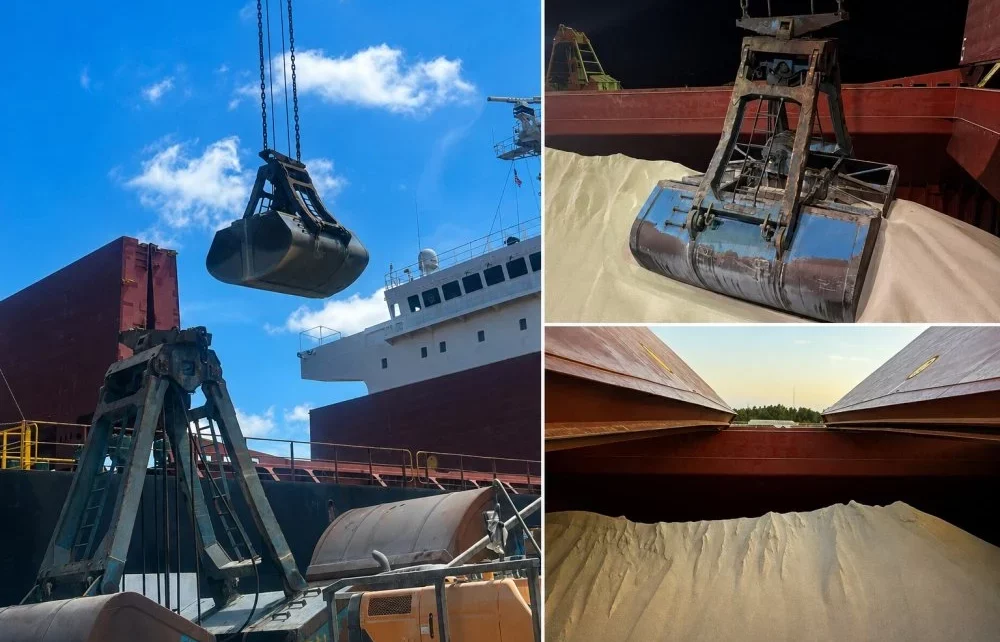
The United States has eased its fertilizer restrictions on Morocco to manage a supply emergency, but the Kingdom could also become a key source of purified phosphoric acid—a crucial product tied to growing competition with China over battery production, supply chain integrity, and access to critical minerals, says Washington Institute for Near East Policy.
In an analysis on U.S. decision to suspend temporarily import duties on Moroccan phosphate giant OCP Group to stabilize American food security, the U.S. institute says Morocco’s massive phosphate reserves position it as a vital strategic counterweight to China and Middle Eastern disruptions in the global fertilizer and electric vehicle supply chains.
The North African Kingdom holds roughly 70% of the world’s total known phosphate rock reserves, making it the undisputed center of gravity for phosphorus-based products. China, which is historically a dominant fertilizer processor, drastically collapsed its phosphate exports due to domestic constraints and export controls, exposing Western vulnerability.
According to the Washington-based Institute, the reliance on Beijing for critical minerals leaves Western food and energy sovereignty at risk, making a partnership with Morocco essential to bypass Chinese and volatile Middle Eastern supply dependencies.
Although this year’s U.S. military hostilities with Iran have remained confined to the Middle East, the war has quite literally reached American soil through the fertilizer market. The Iranian blockade of the Strait of Hormuz in February disrupted greatly global supplies of sulfur and ammonia—materials necessary for turning mined phosphate rock into finished fertilizer, affecting farming around the world.
To ease fertilizer access for American farmers, Washington turned to Morocco, recognizing that the kingdom is a longtime U.S. partner, holds the world’s largest phosphate reserves, and had kept exporting even as other suppliers were cut off, says the American think-tank.
Furthermore, the Moroccan phosphate reserves yield another crucial product: purified phosphoric acid (PPA), a key component in the lithium iron phosphate (LFP) battery cathodes needed for electric vehicles, grid storage, and other sectors. Currently, China refines roughly three-quarters of the world’s PPA, giving U.S. policymakers ample reason to look beyond immediate fertilizer shortages when expanding collaboration with Morocco.
For years the United States shipped its domestically mined concentrate to China, where it was cheaper to process. Yet this created undue dependence on an economic competitor for an indispensable material. The lesson was that owning the raw material is not enough to protect U.S. national security interests when a single foreign country controls the processing.
The U.S. government has only recently come to treat phosphate and its byproducts as strategically important critical minerals. The U.S. Geological Survey added phosphate to its critical minerals list last November, while the White House invoked the Defense Production Act this June to secure supplies of elemental phosphorus. These policy steps treated phosphate as a supply security issue, just like lithium and rare earths.
In February, Washington signed an agreement with Morocco in February to cooperate on critical minerals, says the Washington Institute, noting that
the next supply opportunity in need of attention is battery-grade PPA, which China supplies almost entirely today but Rabat could also produce.
According the American Think-tank, Morocco is not just as a longtime U.S. ally and an emergency fertilizer source in times of crisis, but also a strategic partner in a broader effort whose importance will only grow in the coming years—namely, reducing U.S. and global dependence on China for critical minerals in the LFP battery supply chain.