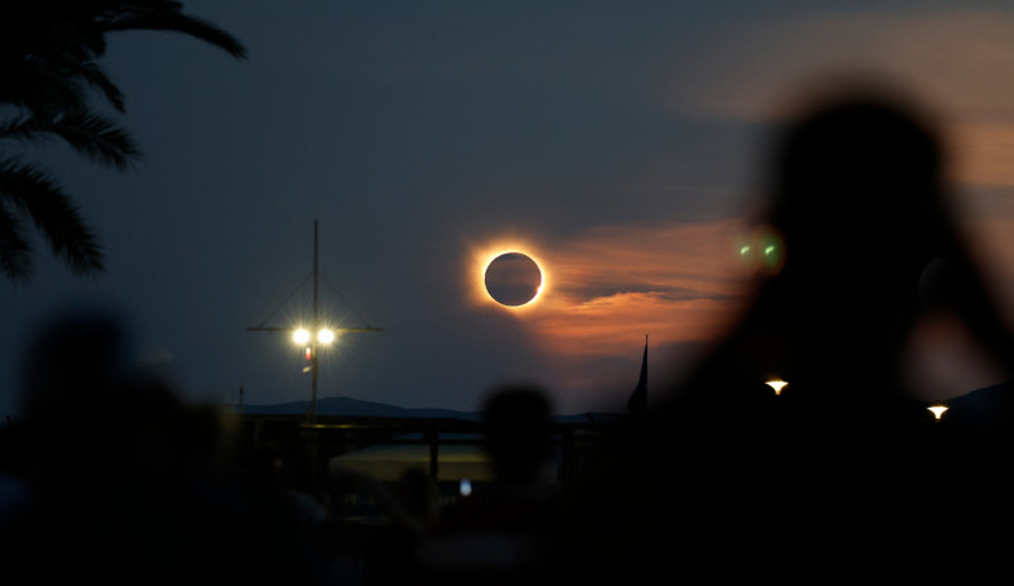
Morocco’s partial solar eclipse on August 12 produced varying occultation levels across the country, most pronounced in the north and gradually weaker toward the south. Tangier recorded the highest rate at roughly 91.97 percent, followed by Oujda at 88.53 percent and Rabat at 82.53 percent, while the rate reached about 79.30 percent in Agadir, 79.20 percent in Marrakech, 69.80 percent in Laayoune and 59.98 percent in Dakhla. The path of totality passed outside the Kingdom, crossing the northern Atlantic before reaching northern Spain and the Balearic Islands.
In Agadir, astronomy researcher Ibrahim Jabel documented the event through photographs beginning around 7:01 p.m., as the Moon started passing in front of the Sun before it neared the western horizon. Jabel explained that a partial solar eclipse occurs when the Moon aligns between the Earth and the Sun, blocking part of the sunlight reaching a given area, with the occultation starting on a small portion of the disc before expanding and then receding as the bodies continue their motion.
Clouds intermittently crossed the sky over Agadir during the observation, occasionally masking the Sun before clearing again, lending what Jabel described as a striking visual quality to the sequence of images, especially as the eclipsed Sun neared the horizon at sunset.
Beyond the spectacle, Jabel used the occasion to highlight challenges facing amateur astronomy in Agadir, citing limited local availability of telescopes and specialised eclipse glasses, along with the absence of dedicated facilities such as an observatory, planetarium or astronomy museum in the city. He argued such spaces could help young people engage with science through direct observation and experimentation.
Jabel also pointed to the historical contribution of Islamic civilization to astronomy, noting that Moroccan scholars from the Muslim West have not always received the recognition their work in observation, calculation and instrument-making deserves, and suggested a museum dedicated to this heritage could connect younger generations with that scientific history.